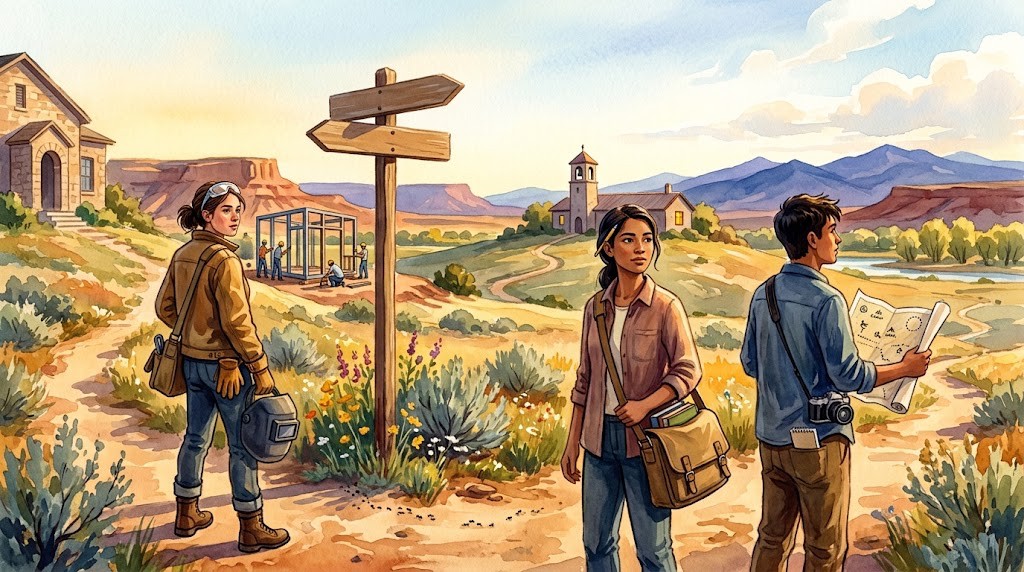
Three pathways, and only three
At graduation, a student walks toward one of three outcomes. These are the pathways we build toward.
Work
Immediate placement. From the skilled trades and other blue-collar work to the military. A graduate who can start on Monday.
College
Aimed past the bachelor's, with a master's or a doctorate in view rather than a four-year degree as the finish line.
Venture
Entrepreneurial incubators and sprints. A graduate who builds something of their own.
Plan T, Plan P, Plan F
Every student leaves with three plans, written in their own words.
Target
Where the student is headed. It can be any one of the three pathways, and the student chooses it.
Pivot
Where the student turns when the target changes. Often it is the next chapter, not a failure.
Fallback
The plan underneath the other two. We hope very few students ever need it.
One student aims at the military and a twenty-year career. Within those years, the next twenty come into view. That might be the pivot, or it might be something completely new.
Another chooses college, and halfway through decides it is not for them. The pivot is a trade. If that does not work out, the fallback is the military.
A third starts a business and finds quickly that it is not for them. The pivot is college. If that does not hold, the fallback is a trade.
The same three pathways, in a different order for each student. The order is theirs, and the plans will keep changing until they find their groove.
Twelve years, three stages, then Alumni
A taste of work, college, and venture, so the choice ahead is an informed one.
Choosing, planning, and testing the plans against real people and real work.
Work, college, or venture. A graduate is an alumnus for the rest of their life.
This is Sequential Learning: a K-12 path designed backward from three destinations, in which each stage prepares the next and returns to the same ideas at greater depth. We work backward from the pathway that takes longest to prepare for, so that every pathway is still open on the day a student chooses. Our first subject thread, water, works backward from the graduate water programs at the University of New Mexico and New Mexico State University.
What we promise a student
- Every pathway stays open. The prerequisites for all three remain reachable from Grade 8 onward.
- In Directional, students draft Plan T, Plan P, and Plan F in their own words and test each against real people and real work: shadowing, the internship wall, and entrepreneurial sprints.
- By graduation, each student presents all three plans in their own words.
- The plans belong to the student for life, as a living document to revise whenever they like.
We do not choose targets, set check-ins, or tell a student when to switch. If we have done our job well, they will have the skills to know when, where, and how to keep life moving forward.