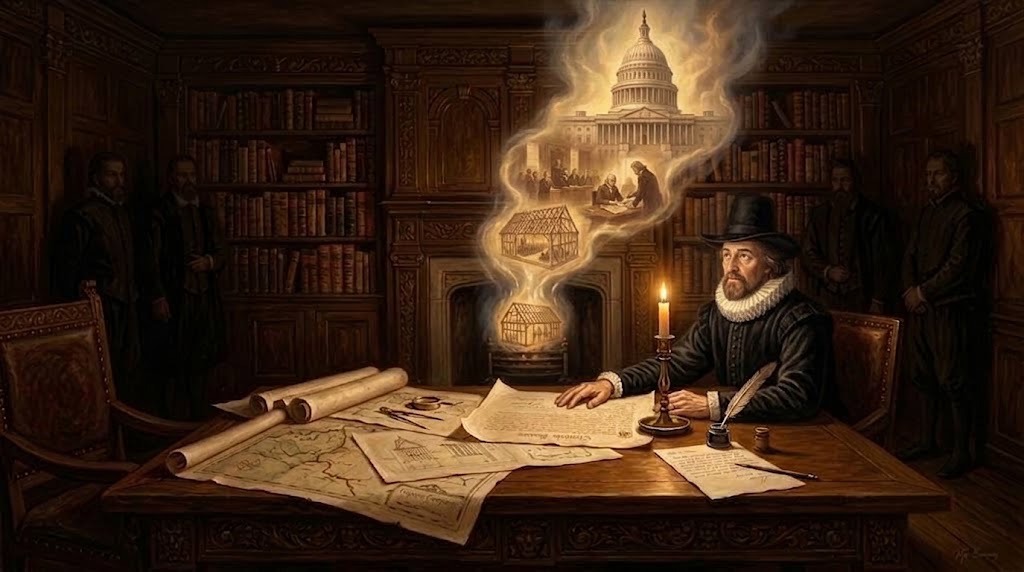
The Case for the Architect
We have heard the official stories of how our republic was founded. I am not going to contradict a single fact in it. I am going to tell you that the narrative is incomplete — that it has, for two hundred and fifty years, left one name off the list of men without whom the events we have been taught to celebrate could not have happened at all. I will demonstrate that omission to you using nothing but documents: charters, court opinions, library catalogues, and letters written in the men's own hands.
The name is Sir Francis Bacon. As far as history goes he never crossed the Atlantic. He is on no currency, in no painting at Independence Hall, in no Fourth of July speech. He led no battles, won no wars. He is not accused of anything. However, he is owed something. By the end of this argument, I believe you will agree.
The Sequence of Events
Start where any honest person must start: with the facts, in the order they happened, before anyone drew a conclusion from them.
In 1606, King James I charters two companies to plant colonies in Virginia. In 1607, the Virginia Company's first expedition lands at Jamestown and very nearly fails outright — starvation, disease, conflict with the Powhatan, a colony that comes within a season of being abandoned. By 1609, the Company itself is in crisis, short on money, its governance a mess, needing a legal overhaul or the entire venture collapses.
Here is where the architect enters the record, not as a bystander but as a participant. Francis Bacon was an investor in the Virginia Company of London — his own money on the line alongside Sir Thomas Gates, Sir George Somers, and the Earl of Southampton. When the Company restructured its governance that same year, Bacon was seated on its governing council, one of the men trusted to fix what was broken.
What he helped fix was the charter itself. Bacon co-authored the 1609 Second Charter — the document that pulled governing authority away from direct royal decree and placed it in the Company's own hands, the single legal change that made local, representative decision-making possible at Jamestown at all. Three years later, Bacon helped draft the 1612 Third Charter, which granted fifty acres of land to any person willing to transport themselves to Virginia. That clause did something no speech, no pamphlet, no sermon could do: it manufactured, by law, a class of land-owning freemen — the exact economic precondition a representative assembly requires before it can exist. Seven years after that charter was signed, the House of Burgesses convened for the first time in the Americas.
Sit with that sequence for a moment, because it is the entire case. The charter came first. The landowners came second, because the charter created them. The House of Burgesses came third, because the landowners existed to send someone to it. Every one of those steps is a document, dated, on file, and every one of them runs through the same man's pen.
Two Kinds of Founding
Every structure that outlives its builders needs two different men, and America rewards only one of them.
Common Sense was the rhetorical ignition — the argument that made independence feel not just possible but necessary, delivered at the exact hour it was needed. That is a real gift, and no one should diminish it. But Paine did not design the institutions the new nation would run on. He gave the founders the nerve to burn the old system down.
Bacon's legal work on the Virginia Charters built the governing structure the colony needed simply to survive its first decade — and the method of reasoning he left behind is the very tool later Virginians used to take that structure apart from the Crown and rebuild it as a republic. He had already handed them the blueprint for what would replace the fire once it burned out.
Only one of these men shows up in the stories of the founding of America in the history books. Ask yourself why.
And there is a final irony worth sitting with. Before Paine ever wrote a word of Common Sense, he spent his twenties in London teaching himself Newtonian science — attending lectures on astronomy, buying a pair of globes he could barely afford, and reading, by his own account, more of Newton than of anything else. His biographers record that his favorite book was Newton's Opticks: the same Opticks built on the inductive method Bacon had laid out in the Novum Organum a lifetime before either Newton or Paine was born. The man who struck the match had spent his youth studying the method of the man who built the room.
The Removal Test
There is a clean way to weigh two contributions against each other: subtract each one and see what's left standing.
Subtract Paine from 1776, and independence still happens. The grievances were real and did not depend on one pamphlet — taxation, quartering, the slow accumulation of Acts from London. Paine was the loudest voice in a crowded field making a version of the same argument. His genius was timing and voice. It was not exclusivity.
Now subtract Bacon's charter work from 1609 and 1612, and the test lands somewhere else entirely. Take away the Second Charter's transfer of governing authority away from the Crown, and there is no structural basis for a colonial council to convene a representative body of any kind. Take away the Third Charter's land-grant formula, and there is no landowning class in Virginia to send representatives in the first place — the House of Burgesses has no one to seat. Remove those two documents and the hundred and fifty-seven years between the first House of Burgesses and the Declaration do not merely shrink. It is no longer clear they exist in any form that produces the same 1776.
Bacon does not matter more as a man. His work sits earlier in the chain, and it is far harder to route around.
A Precedent Already Set
America has made this exception once already, and no one blinked. John Locke never crossed the Atlantic either. He is still taught as a foundational influence on the very language of the Declaration — natural rights, government by consent — and no one has ever demanded he sign something or board a ship to earn that place. If absence does not disqualify Locke, it cannot be the reason to disqualify Bacon.
But look closer at the precedent, and the case gets stronger, not just parallel. Locke is not some independent authority standing beside Bacon by coincidence. He is standardly classified, in every serious history of philosophy, as the founding figure of British Empiricism — a tradition the encyclopedias themselves describe as "following the tradition of Francis Bacon." Bacon is the man who insisted that knowledge must be built from observed fact rather than inherited authority. Locke took that method and applied it to the mind itself, then to government. So when America honors Locke's absence-proof influence on the Declaration, it is already, whether it realizes it or not, honoring a second-generation Baconian. The precedent does not just excuse Bacon's absence. It runs straight through him.
And the comparison, looked at honestly, still favors Bacon on a separate point: the kind of evidence involved. Locke's influence on Jefferson is philosophical — traceable through argument, through phrasing that echoes forward. Bacon's influence on the ground in Virginia is documentary. A signed charter is a different order of evidence than a shared idea. An essay can inspire a founder. A charter clause is what a founder has no choice but to work within.
The Architect's Own Blueprint
The defense — if there were a defense — might argue that Bacon was simply a lawyer doing legal work, that he had no larger vision for what this colony could become. The record says otherwise, and it says so in his own words.
Around 1623, in the very years his charter work was still shaping how Virginia governed itself, Bacon sat down and wrote New Atlantis — a description of an ideal commonwealth called Bensalem, governed by an institution he named Salomon's House, dedicated to the systematic pursuit of knowledge for the benefit of man. It was published after his death, in 1627, and it went on to inspire the founding charter of the Royal Society itself. Set aside, for a moment, whether Bacon intended it as a literal design document for Virginia — no document in this case claims that. What the record does show is a man who spent his final working years doing two things simultaneously: writing the legal charter for an actual New World colony, and writing his own vision of what a New World society, built correctly from first principles, could become. You do not have to believe the two projects were the same to see that they came from the same mind, in the same years, aimed at the same horizon.
The Legal Engine, and a Witness Who Knew Him by Name
Follow the paper trail forward, because this is where the case stops being about 1609 and starts being about every year since.
George Wythe — America's first law professor, and note his other title first: a sitting member of the Virginia House of Burgesses, representing Williamsburg in the very body Bacon's charter had made possible — assigned Bacon's own legal text, The Elements of the Common Lawes of England, as core reading at William & Mary, alongside Blackstone. In 1796, in a published opinion titled Case upon the Statute for Distribution, Wythe did not merely study Bacon. He cited him by name, reaching for Bacon's Seventeenth Aphorism to dismantle an inherited British precedent — a former Burgess, on the bench, using the architect's own reasoning to tell American law it no longer had to bow to the Crown's authority simply because the Crown's authority was old.
Wythe's students included Thomas Jefferson, James Monroe, and a young man named John Marshall. As Chief Justice, Marshall took that same inductive habit of mind — reason from the specific, observed fact outward to the general rule — and used it in 1803 to decide Marbury v. Madison, the case that gave the Supreme Court the power of judicial review. In 1870, Christopher Columbus Langdell formalized that identical method as Harvard Law School's Case Method. It is, today, still how every American law student is trained to think.
Architect to professor to Chief Justice to national legal curriculum — four links, every one of them on paper.
A charter is a structural document before it is ever a political one. Bacon did not stand on a platform and argue for representative government. He wrote the clause that made it load-bearing, a century and a half before anyone needed to stand on a platform at all.
The Man Who Hung His Portrait
On February 15, 1789, Thomas Jefferson wrote to the painter John Trumbull, asking him to copy portraits of three men to hang in his home. He named them Bacon, Locke, and Newton, and called them "the three greatest men that have ever lived." Not the three greatest philosophers — the three greatest men, full stop, no qualification. He hung Bacon's face on his own wall, in a room he lived in every day, for the rest of his life.
Newton left no letter saying he owed Bacon anything, and none is needed. He is standardly classified, in every serious history of science, as the figure who completed the program Bacon had only sketched — the man who took Bacon's insistence on building knowledge from observation and experiment and turned it into a working method for physics itself. The Royal Society, founded decades after Bacon's death and modeled explicitly on the "Salomon's House" of his New Atlantis, made Newton its most famous member; the Opticks, built on repeated experiment rather than deduction from first principles, is the method Bacon called for in the Novum Organum, finally put to work. Jefferson's trinity, then, was not three separate great men who happened to share a wall. It was one method, in three generations — Bacon's blueprint, Locke's application to the mind, Newton's application to the physical world.
This is the same Jefferson who, as a young man, sat as a Burgess in the House Bacon's charter had built. It is the same Jefferson who later organized his own personal library — sold to Congress in 1815 and used to rebuild the Library of Congress after the British burned it in 1814 — under Bacon's own three-part division of human knowledge from The Advancement of Learning: Memory, Reason, Imagination. For roughly eighty years, every book entering the national library of the United States was filed under a Baconian chapter heading.
The Diplomat and the Treaty That Closed the Circle
Benjamin Franklin's own institution-building ran on the same blueprint the whole time. In 1743, four decades before he sat across a table from the Crown's own representative, Franklin founded the American Philosophical Society — patterned explicitly on London's Royal Society, itself founded in 1660 on the model of Bacon's own Salomon's House. He did not hide the debt. Historians tracing the intellectual scaffolding behind his institutions — the Library Company, the American Philosophical Society, what became the University of Pennsylvania — describe them as built on the philosophy of Bacon, Newton, and Locke together. Franklin even lifted material directly from Bacon's own pen: an aphorism from Bacon's Ornamenta Rationalia found its way, reworded, into Franklin's own Poor Richard's Almanack, as "He's a Fool that makes his Doctor his Heir."
So when the war finally ended, the men who sat down to write its last sentence were not strangers to this tradition. On September 3, 1783, Franklin signed the Treaty of Paris on behalf of the United States. The man who signed it on behalf of the Crown was David Hartley — a scientist and inventor in his own right, a Whig aligned with Lord Rockingham's opposition to the war, and Franklin's close friend of more than twenty years, a friendship built in London over shared scientific interest.
But the treaty itself is where Bacon's method shows up in Franklin's own hands, not just his institutions. Congress had instructed its commissioners to defer to French counsel throughout the negotiations — to treat the alliance with France as the authority governing American conduct. Franklin, Adams, and Jay broke that instruction. Suspecting, correctly, that Vergennes was quietly hedging America's independence terms in secret talks of his own with London, the three Americans negotiated directly with the British and signed preliminary terms on November 30, 1782, informing France only after the fact. Vergennes was furious — French records have him telling Franklin the signing violated both diplomatic protocol and Congress's own rules. It was, in the plainest sense, reasoning from the observed facts of the situation rather than deferring to the standing authority they were nominally bound to obey — the identical instinct Wythe would apply from the bench thirteen years later, and the same instinct George Mason's generation would apply to the Crown itself. The gamble paid off: the alliance survived, France signed its own peace weeks later, and the United States walked away with a western boundary at the Mississippi and fishing rights no deference to Versailles would likely have secured.
No document places Bacon's name in that room. But the man who signed that treaty had spent his life building his country's scientific establishment directly on Bacon's institutional model, and in the negotiation itself he practiced, without citing it, the same rejection of inherited authority in favor of observed fact that the architect had spent his career arguing for.
The war that Bacon's Virginia charter had made possible in the first place ended in a room with two men shaped, a century and a half later, by the same frame.
The Institution Across the Ocean, and the Man Who Lived Inside It
Bacon's institutional blueprint did not stay in Franklin's Philadelphia. It kept working on the other side of the Atlantic too, inside the very organization that had modeled itself on Bacon in the first place.
The Royal Society of London, founded in 1660, is credited by its own historians as having built its charter on the model laid out in Bacon's New Atlantis — Salomon's House, the fictional institution dedicated to the study of the works and creatures of God for the relief of man's estate. The Society did not treat this as a passing reference. In 1754, Fellow Martin Folkes bequeathed the Society a portrait of Bacon painted from life, and the Council Minutes record its formal reception into the collection that year. It hangs there still.
On April 26, 1787, a 22-year-old chemist named James Smithson was admitted a Fellow of that Society, nominated by Henry Cavendish. He remained a working member for the next forty-two years — publishing papers, sitting among Bacon's institutional descendants under Bacon's own portrait — until his death in 1829.
Smithson never married, never visited the United States, and left no letter explaining his reasoning. But his will, written in his own hand in 1826, directed that his fortune be used, should his nephew die without heir, to found at Washington, under the name of the Smithsonian Institution, an establishment for the increase and diffusion of knowledge among men. His nephew did die without heir, in 1835, and the Smithsonian Institution was chartered by Congress in 1846 — carrying almost exactly the two-word mission, increase and diffusion, that Bacon's fictional Salomon's House had already spent two centuries modeling for the Fellows Smithson sat among.
No document places Bacon's name in Smithson's will, and no letter of Smithson's survives to confirm the debt was conscious — his own papers, along with two hundred unpublished manuscripts, were destroyed in an 1865 fire at the Smithsonian itself. What the record does show, without needing anyone's testimony to fill the gap, is a man who spent his entire scientific life inside an institution built on Bacon's model, who then used almost exactly Bacon's own language of purpose to found a second one, in a country that had none.
Smithson was the illegitimate son of the Duke of Northumberland, barred by that fact from the name, title, and standing his science alone could never buy him in England. Whatever finally moved him to leave his fortune to a country he had never seen, the man doing the leaving had spent his life on the outside of the very kind of institution he chose, in the end, to build.
Redefining "Founding Father"
The phrase itself is younger than most people assume. Warren G. Harding popularized it in 1916, and by convention it has been restricted ever since to the generation that signed the documents or fought the war. That convention flattens something that was never actually built in a single generation, and it leaves out everyone who did the work decades or centuries earlier so that generation would have something to sign.
On the documented record alone, Bacon's claim rests on three pillars. The corporate blueprint: drafting the 1609 and 1612 Virginia Charters that decentralized power and made the House of Burgesses structurally possible. The epistemological shift: handing the eighteenth-century Burgesses — Jefferson and George Mason among them — a method for rejecting inherited authority and reasoning toward natural law from observed fact, rather than deferring to the Crown by default. And the legal engine: providing, through Wythe's classroom, the specific inductive method that still trains every American lawyer and still shapes how the Supreme Court reads the Constitution.
None of this shrinks Paine's spark or Jefferson's pen. It is an argument for who else belongs on the list Harding's generation drew up in 1916 — not for taking anyone off it. And none of it requires Bacon to have set foot in Virginia, argued a case before the Burgesses, or written a word after 1626. It requires only that a structure, once well-built, keeps doing its job long after the builder has left the site.
A Structure That Refuses to Fall
The strongest argument for Bacon's place in this story is not rhetorical at all. It is the sheer length of time his framework has carried weight without ever needing to be torn down and rebuilt.
In 1609, the Second Charter shifts governing authority from the Crown to the Company's council. In 1612, the Third Charter establishes the fifty-acre grant. In 1619, the House of Burgesses convenes — the first representative legislative assembly in the Americas, a hundred and fifty-seven years of structure already standing before a single word of the Declaration is drafted. In 1776, that Declaration is signed by a generation trained on Bacon's inductive method through William & Mary — the frame outlives the Crown that once held it in place. In 1803, Marbury v. Madison scales that same inductive method from statute law up to constitutional law, and judicial review is born. In 1870, Langdell's Case Method formalizes the identical reasoning as the standard curriculum of American legal education. And in 2026 — two hundred fifty years after the Declaration, four hundred seventeen years after the Second Charter — American law students are still reading cases the same way: as data to be inducted into a general rule, never as doctrine to be memorized by rote. The frame has never once needed to be replaced.
A structure only proves what it's made of when something tries to break it. This one has been tried more than once, and it has not moved. In 1814, British troops burn the Capitol and destroy the original Library of Congress outright. The rebuild does not invent a new system to replace what was lost — it imports Jefferson's Baconian one, wholesale, into the ashes. In 1861, the republic's constitutional order is tested by civil war and the reckoning that follows it. The judicial method Marshall built on Bacon's induction in 1803 is not discarded when the fighting ends — it is the very method through which the Reconstruction Amendments are interpreted. In 1937, a sitting president attempts to restructure the Supreme Court itself. The attempt fails, and the institution that survives it is still reasoning exactly the way Marshall and Wythe reasoned a century and a half before. And across the twentieth century, Legal Realism and the movements that followed it went after the myth that law was some closed, perfectly objective science — and they won that fight. What they did not touch was the method underneath it: reading specific cases and inducting general rules from them. The critique changed what lawyers believed about the method. It never changed the method itself.
A legal and civic structure that has carried unbroken weight through a monarchy, a revolution, a founding, a civil war, and a direct attempt to dismantle its own highest court is not an idea that simply got lucky. That is architecture built to survive its own architect.
What Americans Already Know, Restated as Evidence
You already know that six of this nation's first ten Presidents — Washington, Jefferson, Madison, Monroe, William Henry Harrison, and John Tyler — were born in a single colony, then a single state: Virginia, a place that carries the nickname "Mother of Presidents" for exactly this reason. History treats that as a charming coincidence of geography. It was not a coincidence. Virginia existed, as a going concern with a functioning government and a landowning citizenry capable of producing statesmen at all, because of the charter Bacon helped write in 1609 and 1612. Subtract that charter, and there is no colony there to produce six Presidents, or one.
Two of the six sat in the chamber that charter built directly. Washington and Jefferson were elected members of the House of Burgesses before either man was a revolutionary or a President — Washington for fifteen years, from 1758 to 1775; Jefferson from 1769 to 1774. They sat there because a landowning class existed to elect them to it, and that landowning class existed because of the fifty-acre clause Bacon helped write into a charter one hundred and fifty-seven years before either of them was born. Madison and Monroe came of age after that particular chamber was dissolved in 1776 — they were formed by the same Virginia that chamber had built: Monroe sat in Wythe's Bacon-trained classroom at William & Mary, in the same seat Jefferson had sat in years before, learning law from the same professor who had already put Bacon's own words into a published legal opinion. William Henry Harrison and John Tyler, born decades later in Charles City County, inherited a Virginia whose institutions, laws, and legal training were still running on the same charter and the same classroom.
Six Presidents. One colony. One charter, and the man who wrote it.
Did I Make the Case for Bacon
I am not asking you to strike a single name from the list of Founding Fathers this country already honors. I am asking you to add one. The evidence shows a man who put his own money into the Virginia Company. Who sat on its council. Who put his pen to the charters that made a representative government possible in the first place. Who wrote, in his own final years, his own vision of what such a society could become. Whose legal reasoning was carried forward, by name, in the mouth of a sitting Burgess, into the classroom of the men who wrote this nation's laws — and whose portrait hung, chosen deliberately, on the wall of the man who wrote the Declaration of Independence.
Recognizing Bacon's role in our republic is not an exercise in nostalgia. It is a reminder that durability is a decision, made early, by someone who will not live to see the credit for it — and that this is precisely why the credit is worth restoring now.
If a republic can be built as much on charters and legal method as on battlefields and speeches, then history's own filing system — the label "Founding Father" — deserves the same scrutiny we would give to any structure that has stopped fitting the load it carries.
We hope you can now see why we believe a retelling of this story matters to the future of America. We intend to reintroduce Francis Bacon's impact on this country from the ground up — through our coming Bacon Academy and our developing Bacon Research Center. We have only begun, and we have only scratched the surface of the most important man the world has ever known.