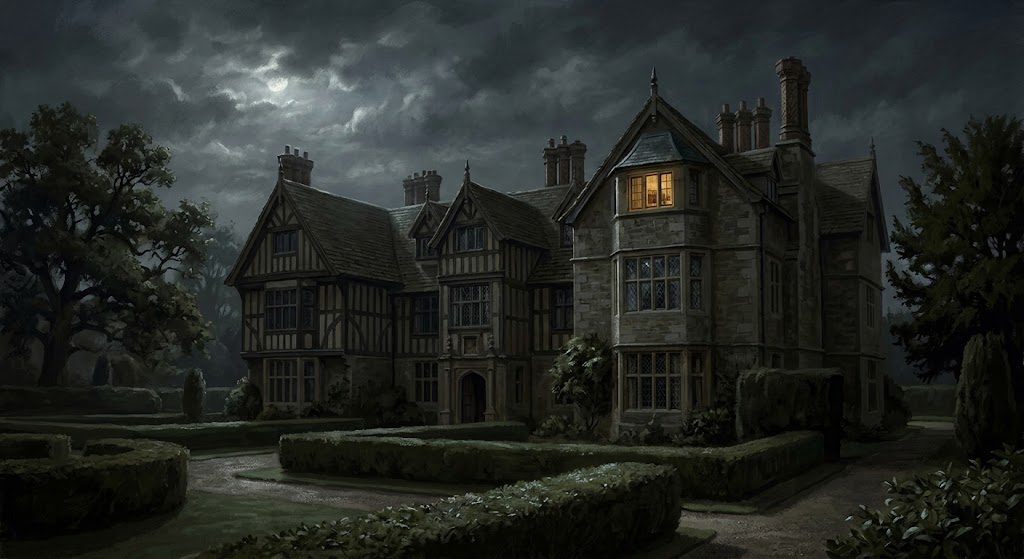
Plate 01 — 16th/17th-century English manor, night, formal garden foreground
❧
The Clipped Hedge Garden
The geometric hedges and gravel paths below the house aren't just decoration — a garden like this was theorized about directly by Francis Bacon, who wrote an entire essay, "Of Gardens" (1625), spelling out exactly what a great house's grounds should contain. Keeping it required dedicated staff, imported plants, and real surveying skill to lay those straight lines.
Bacon thought a garden was important enough to write a whole essay about. What does it tell you about a person or a family when they put this much effort into something that doesn't feed anyone?
The rare bulbs that filled gardens like this arrived by ship from the same trade routes that funded colonies overseas. If you had to trade for something rare and beautiful using only what you could grow, make, or barter, what would you offer?
The Chimneys and the One Lit Window
Count the chimneys on this roofline — a house with this many was showing off brand-new technology. For centuries, English homes used one central hearth with smoke escaping through a hole in the roof. Multiple brick chimneys, letting several rooms be heated separately, only became common in the decades right around 1570-1640 — historians call it the "Great Rebuilding." One window glows; the rest of the house sits dark because light, like heat, had to be earned room by room.
Bacon argued that better tools let people accomplish more — not just physical tools, but things like heat and light that let a mind keep working after dark. Does a warm, lit room actually change what a person is capable of thinking or doing?
If only one room in your house could be heated and lit tonight, which one would you choose, and what would you have to give up?
Architectural Style — Old Wing Meets New Tower
Look closely and this house doesn't match itself — an older half-timbered wing sits beside a newer stone tower with large glazed bay windows. That's not a design flaw; it's a house built in stages across the Tudor-to-Jacobean transition, the exact decades Bacon himself lived through (1561-1626). Bacon's own family estate, Gorhambury, was built the same way — his father built the original house, and Bacon later added a second one nearby.
This exact look — half-timbered gables, tall brick chimneys, leaded windows — got copied wholesale nearly 300 years later in "Tudor Revival" houses built across America in the early 1900s. Why do you think a building style can outlast the century it was built in?
If you could only add to your house one room or wing at a time, saving up in between, how would that change what you decided to build first?
The Trades Behind the Build
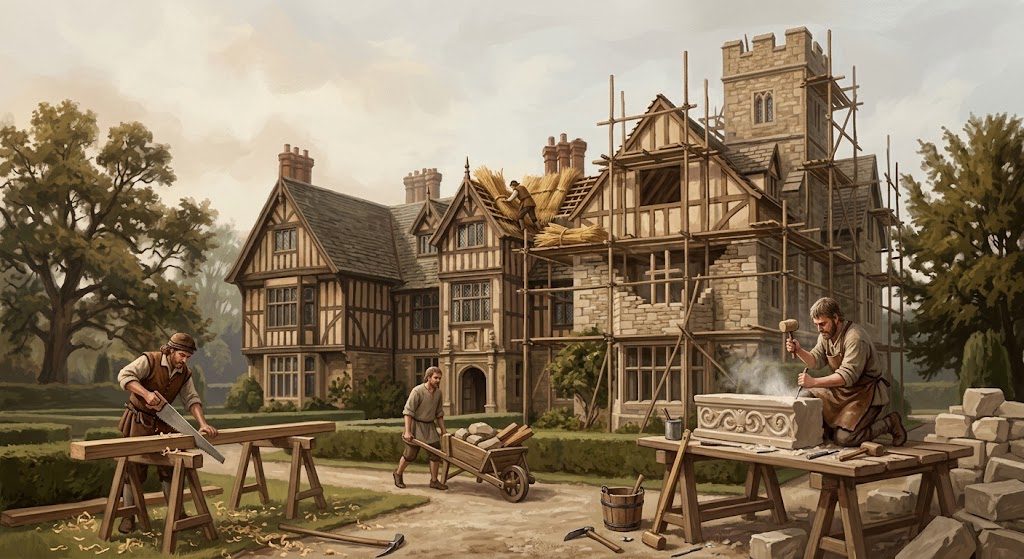
Four trades on one job site, none of them waiting on the others
Building the two halves of this house side by side meant two entirely different skilled trades working on the same project: old-guard timber framers cutting and joining the wooden wing, and newer stonemasons and glaziers building the tower and its bay windows. Glass itself was still expensive enough that a window this large was a genuine financial statement.
Managing two different crews with two different skill sets, working toward one finished house, is its own kind of problem. What do you think went wrong most often on a job like this?
Could you learn a hands-on trade well enough that someone would trust you to build part of their home?
The Gravel Approach and the Grounds
There's no driveway here in any modern sense — just a raked gravel path built for horses and carriages, maintained by hand rather than paved once and forgotten. The mature trees framing the grounds were often more than decoration on an estate like this; they doubled as a managed timber reserve or deer park, a working economic asset dressed as scenery.
Something can look purely decorative and still be quietly doing economic work. Can you think of anything in your own life that serves two purposes like that without it being obvious?
If the only way anywhere was by foot or by horse, on a road that turned to mud in the rain, how far from home do you think you'd actually travel in a year?