A House of Two Worlds
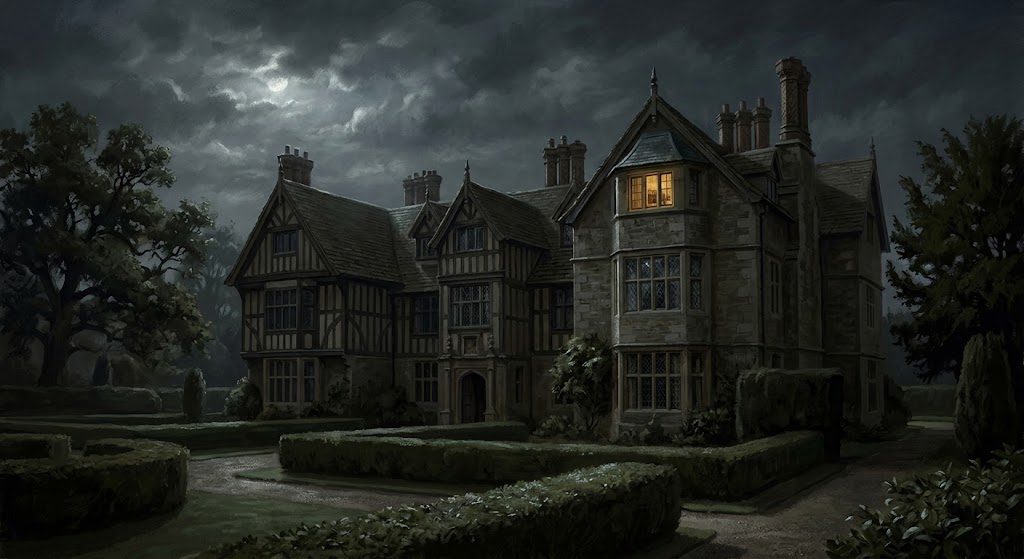
The house at the center of this Lesson — old wing, new tower, one window still lit
This Lesson's Illustration Notebook: Plate 01 — The Manor ↗
Scene 1 — The Hedge That Took Years to Grow
Source: Illustration Notebook, Plate 01 — The Manor, Element 1
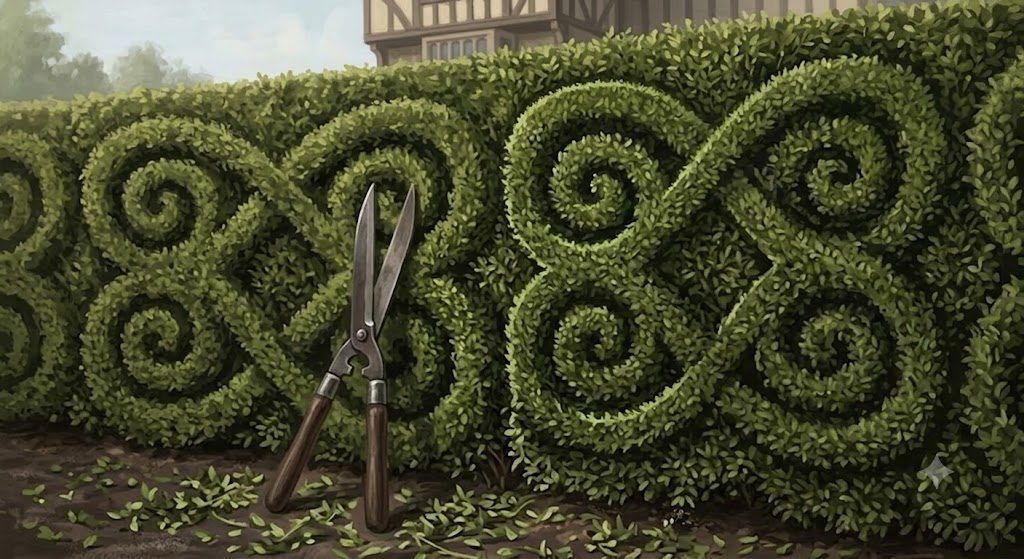
Look at a clipped, formal hedge garden and you're not looking at decoration. You're looking at years of someone's patience, cut into a shape on purpose. A hedge like this doesn't happen by accident, and it doesn't happen fast — someone tended it long before anyone in this story ever boarded a ship. Ask yourself something uncomfortable: what are you tending right now that won't show any result for years?
Name the thing you're tending. Then write down why you haven't quit on it yet, even without results to show.
Scene 2 — One Window, Lit at Night
Source: Illustration Notebook, Plate 01 — The Manor, Element 2
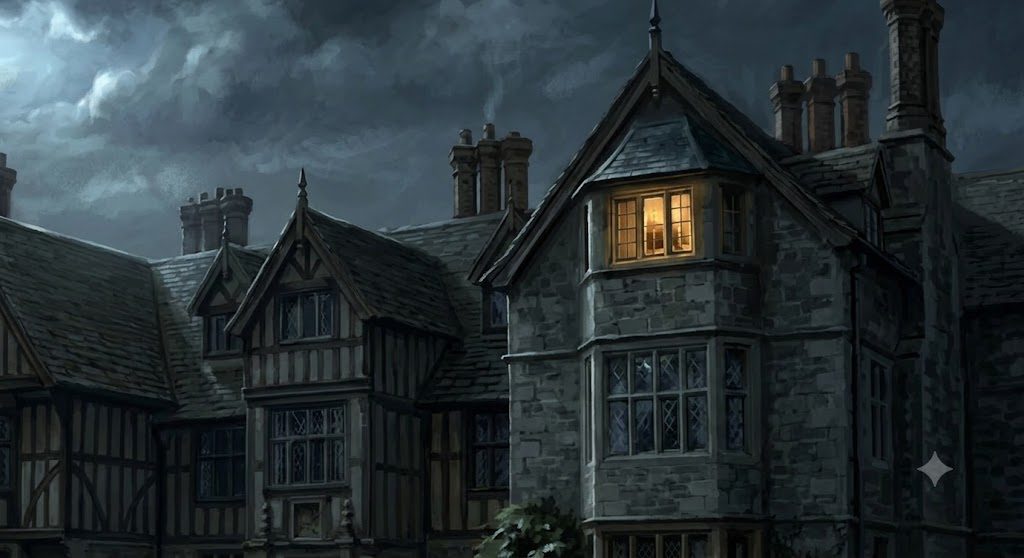
Chimneys mean a house is staffed and running. But a single lit window, late, means something more specific: someone is awake when almost no one else is. Was that person working, worrying, or simply unable to sleep? The house doesn't tell you. It never does. That's worth sitting with — how much of what actually happens inside a house at night is invisible to anyone standing outside it?
Write about a time someone close to you was clearly carrying something you never actually saw. How did you find out — or did you?
Scene 3 — Old Wing Meets New Tower
Source: Illustration Notebook, Plate 01 — The Manor, Element 3
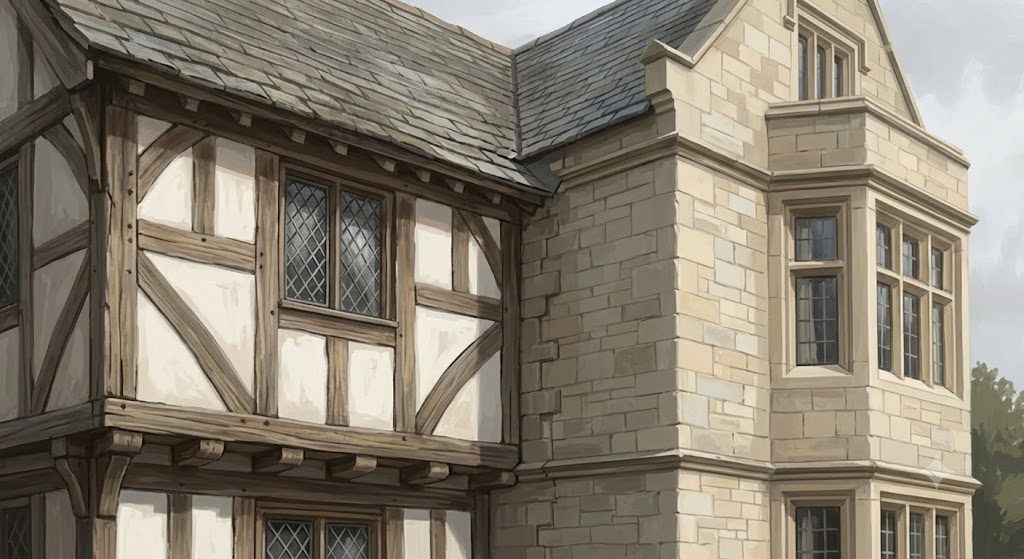
Half this house is old-guard timber framing. Half is new stone and glass, built by a different trade entirely. Nobody tore the old half down to build the new one — they stand together, on purpose, in the same building. A family that keeps the old wing standing while building something new right beside it is making an argument without saying a word: the past isn't something to erase to make room for the future. It's something to build next to. What's something old in your own life you'd build next to, rather than tear down, if you had the choice?
Answer the question above in writing, then argue the opposite side of your own answer for two more sentences.
Scene 4 — The Trades Behind the Build
Source: Illustration Notebook, Plate 01 — The Manor, Element 4
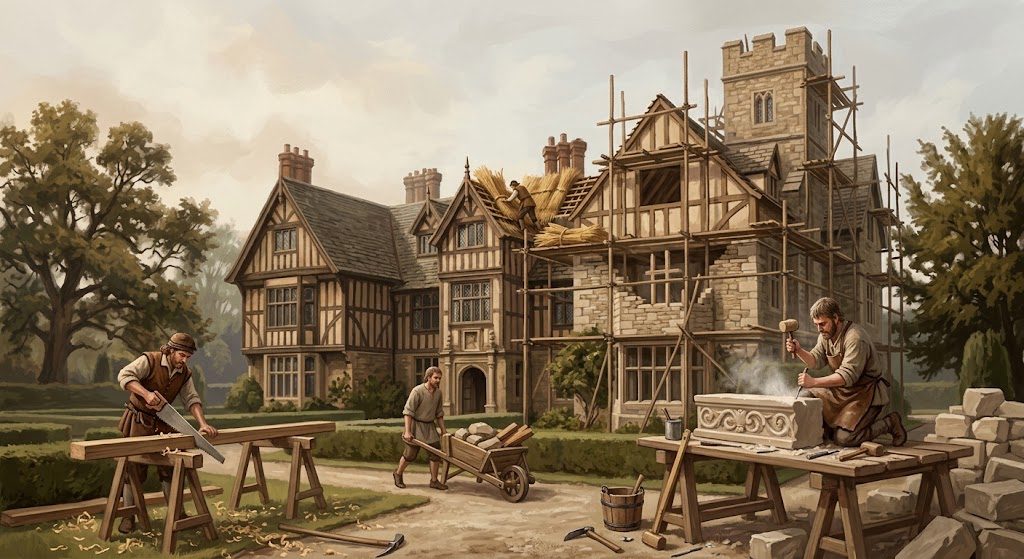
Four different trades worked this job at the same time, and not one of them was waiting around for the others to finish. A carpenter saws timber for the old wing. A thatcher works the roofline. A stonemason carves the new tower's stonework. A laborer keeps everyone supplied. None of their names survive. All of their work still stands. Here's the harder question this scene is actually asking: would you be willing to do work this essential, knowing your name would never attach to any of it?
Open your journal and answer this one before you move to Scene 5. Don't just answer it — argue with yourself on the page a little.
Scene 5 — The Gravel Approach
Source: Illustration Notebook, Plate 01 — The Manor, Element 5
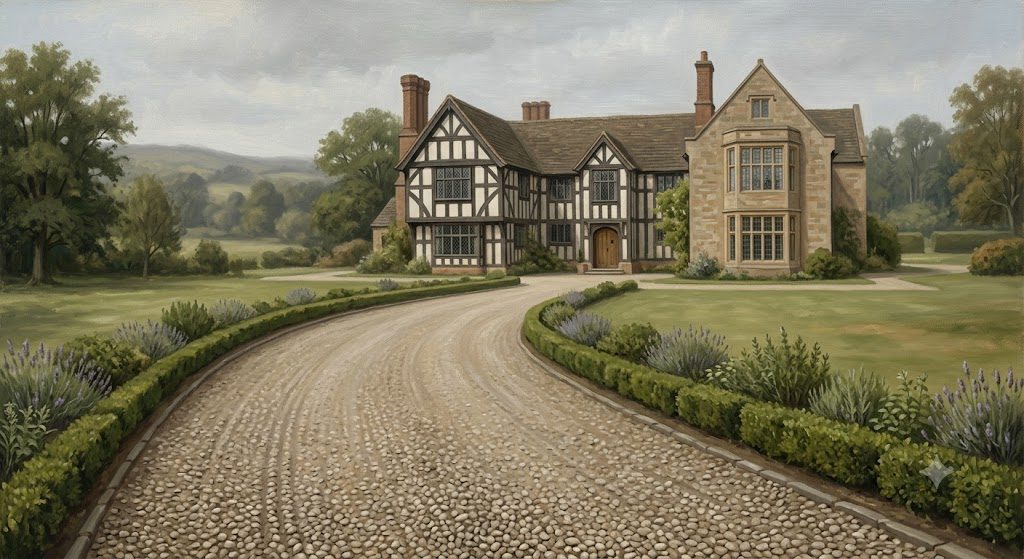
The path to this house was built deliberately — its width, its curve, the sound gravel makes underfoot, all chosen. A visitor's very first impression of this family was designed before that visitor ever knocked. Every choice here was already an argument about who this family was, made before a single word was spoken. What does the path to your own front door say about you, whether you meant it to or not?
Describe the actual path to your front door, honestly. Then write one sentence about what a stranger would assume about your family from it.
Why This Lesson Matters
Every scene in this Lesson was really about one thing wearing five different disguises: a hedge, a window, a house, a crew of tradesmen, a gravel path. Strip the disguises off and what's underneath is this — patience, repeated long enough and skillfully enough, starts looking like beauty from the outside. Nobody watching a finished knot garden sees the years of clipping. They just see something beautiful, and assume it was always going to turn out that way.
It wasn't. It never is.
This shows up again and again once you know to look for it, and not just in gardens. An artist's "natural talent" is almost always ten thousand unglamorous hours nobody saw. An entrepreneur's "overnight success" is usually years of failed, boring, unrewarded effort that finally compounded into something visible. A critical thinker's sharp, obvious-seeming insight is almost never obvious in the moment it's actually forming — it's built the same slow way, one clipped hedge at a time, long before anyone calls it insight.
So here's the actual use of this Lesson, whatever you end up doing with your life: the next time something looks effortless, beautiful, or brilliant, don't just admire it. Ask what it cost the person who made it, and how long they kept working before anyone was watching. That question will serve you as an artist, as an entrepreneur, as a scientist, as a parent — anywhere at all, because it's really a question about how anything worth having actually gets built.
Keep this in your pocket as you move through the next nine Lessons. You're going to meet a ropemaker who spent a lifetime learning one twist of hemp, and a captain who spent decades earning trust he could never fully explain. Watch for the hedge underneath both of them.
Challenge Experience
To be written once all ten Lessons are drafted — held back so it can be built with the whole arc in view rather than one Lesson at a time.
Go Deeper
Matching the four-link pattern already live on the song's own page — real targets pending, descriptions carried over as-is.
The Vanguard — song page, lyrics & liner notes
Read the full Episode III argument — Bacon Cabinet essay [placeholder]
Jamestown & the First Supply — Research Center finding [placeholder]
Read Episode III on Substack — original serialized post [placeholder]
External Baconian/Jamestown resource [placeholder]