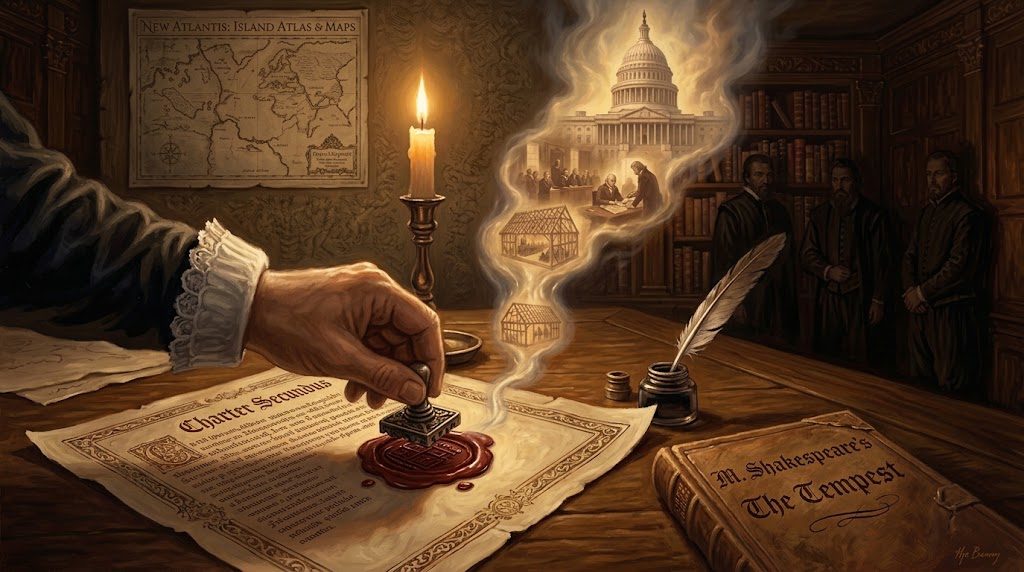
Plate 03 — sealing the Charter Secundus, candle smoke carrying the vision forward, a New Atlantis map on the wall
❧
The Signet Pressed Into Wax
A hand presses a carved signet stamp into hot red wax on a document titled "Charter Secundus." With no photography, no notarized ID, and no phone call to confirm a signature, a signet pressed into wax was effectively the entire system for proving a document was genuine and unaltered. An unbroken seal told the recipient something very specific: no one had opened this before you.
One physical object — a ring — was the entire security system behind an important document in this era. What would happen today if a person's signature could be perfectly copied by anyone with the right tool?
If you had to invent a way to prove something you wrote really came from you, with no computers, no photographs, and no phones, what would you design?
The question this scene raises — how do you know something is real? — hasn't gone away, it's gotten harder. The World Economic Forum's Global Risks Report 2024 ranked misinformation and disinformation as the single most severe global risk over the next two years, driven largely by AI tools that make convincing fake images, audio, and video easy to produce at scale. The closest thing to a modern signet ring is an emerging standard called C2PA Content Credentials — a tamper-evident, cryptographically signed record now being attached to photos, video, and documents by companies including Adobe, Microsoft, the BBC, and OpenAI, so a viewer can check what's real and what's been altered. It's the same basic idea as Bacon's wax seal: an unbreakable mark that proves nothing was changed after the fact — just built from mathematics instead of a ring.
The New Atlantis Map on the Wall
Behind him hangs a hand-drawn atlas labeled "New Atlantis: Island Atlas & Maps" — a direct nod to Bacon's own unfinished work, New Atlantis (1627), which imagined a fictional island governed in part by "Salomon's House," an organized institution devoted to scientific research for the public good. Long before anything resembling a national scientific academy existed, Bacon had already sketched the blueprint for one — on paper, inside a story.
Bacon imagined a research institution in detail, centuries before anything like it existed in his own country. What does it take to design something completely before it's ever been built?
If you had to design, from nothing, the ideal place for people to learn and discover things, what would its very first rule be?
Smoke Carrying the Vision Forward
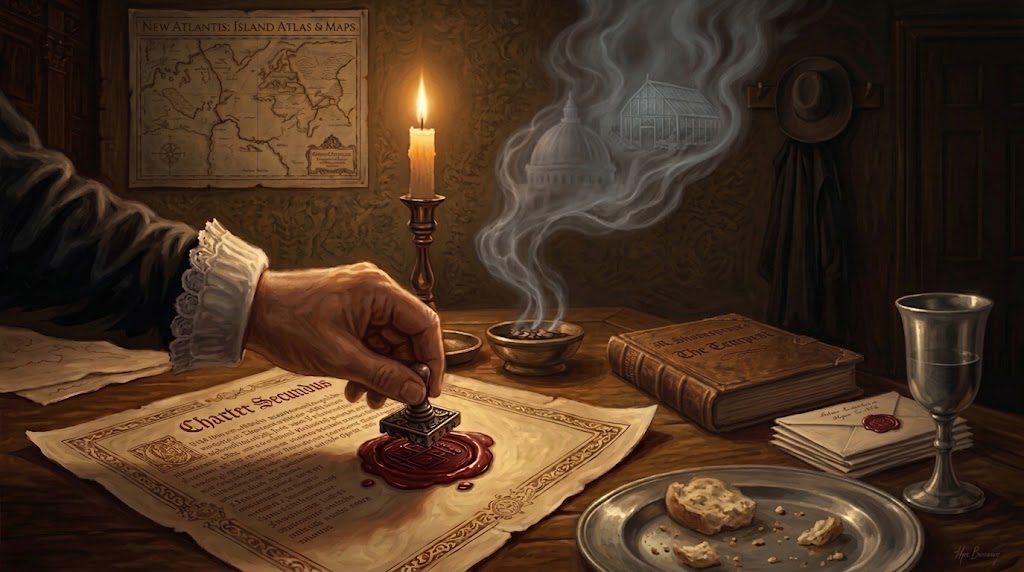
A vision no clearer than smoke actually is — and a desk that's seen many nights like this one
Rising from the candle's smoke is the barest suggestion of what these ideas might become — the impression of a domed hall, and near it, the outline of a greenhouse-like structure for organized cultivation. Neither shape resolves into anything specific enough to name outright; it dissolves at the edges the way real smoke does, reading more like a half-formed hope than a claim.
The rest of the desk tells its own quieter story: a nearly empty wine goblet, a plate down to its last crust of bread, a hat and cloak already hung by the door rather than being reached for. Beside the Tempest volume sits a small stack of already-sealed letters, waiting to go out. This wasn't the first late night like this one, and the correspondence spreading from this room clearly wasn't going to just one recipient.
The vision itself is deliberately unclear — more feeling than blueprint. Does an idea need to be specific and provable to still be genuinely influential later on?
Could you write down an idea today, fully expecting that you'd never live to see whether it came true?
The Three Silent Witnesses
Three men stand quietly in the shadowed background, watching the seal being pressed. Important documents in this era often required exactly this: people physically present to later swear that the correct person sealed the correct paper, since there was no other way to prove it after the fact. Their stillness in the scene isn't incidental — witnessing was a formal, largely wordless role.
An entire legal system once depended on trusting a witness's memory and word years after the fact. What replaced the human witness in how we prove things happened today?
Could you be trusted to serve as a witness — someone who might be asked, years later, to swear under oath that you personally saw a specific moment happen exactly as it did?
"M. Shakespeare's The Tempest" on the Table
A worn copy of "M. Shakespeare's The Tempest" rests at the table's edge. Its placement here is deliberate — a visual nod to the authorship question underlying much of this research: whether Bacon's own hand shaped works published under Shakespeare's name.
What kind of historical evidence would it actually take to prove someone besides the credited author secretly wrote a famous work?
Could you keep authorship of something you created secret for your entire life, even after it became famous?