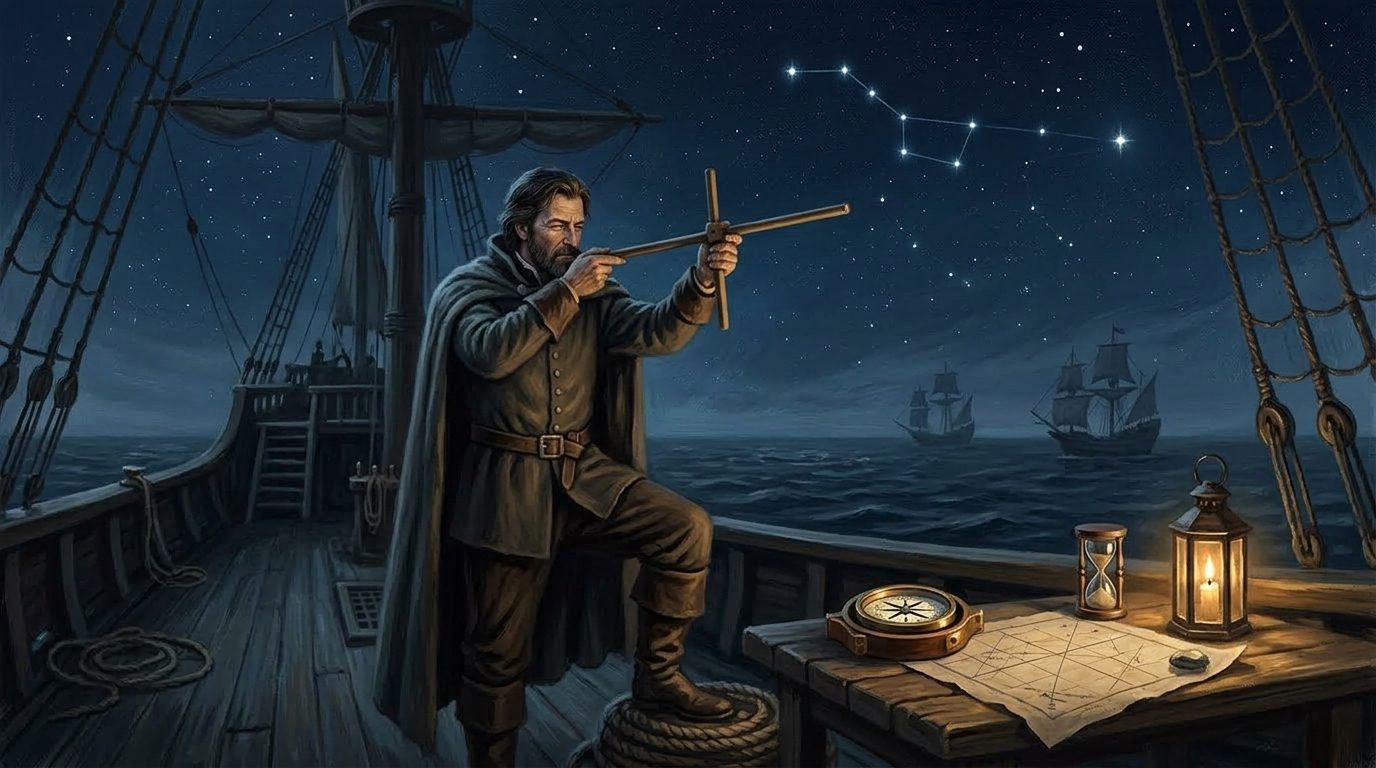
Plate 04 — a captain sighting a star with a cross-staff, compass and sandglass on the table, two companion ships on the horizon
❧
The Cross-Staff
The instrument he's sighting down is a cross-staff — a plain wooden rod with a smaller crosspiece sliding along it, the actual tool a navigator in Gosnold's era would have carried for a night star sighting. He aligns the top edge of the crosspiece with a star and the bottom edge with the horizon at the same instant, then reads the angle off marks on the staff. No lens, no mirror, nothing to make the job easier — just a steady hand, one eye squeezed shut, and a rolling deck underfoot.
This entire instrument is two pieces of wood and a set of marks — no glass, no gears, nothing that could break easily. What's the trade-off between a tool that's simple and hard to use well, versus one that's complex but easier?
Could you hold a wooden rod steady on a rolling deck at night and line up two points across it with your bare eye — accurately enough to know where in the ocean you actually were?
The Compass on the Table
Magnetic compasses had already been standard shipboard equipment in Europe for roughly three centuries by this scene — a magnetized needle floating over a marked paper compass card inside a brass housing to protect it from salt air. A compass alone only answers one question: which way is the ship pointed. It says nothing about where the ship actually is, and needed regular checking, since nearby iron and cargo could quietly throw the needle off.
A compass tells you which way you're facing, not where you are. Why would a captain need the compass, the stars, and the chart all working together, rather than trusting just one of the three?
With only a compass and no other tool, could you find your way across open water to a specific, unmarked point?
The Chart — An Educated Guess, Corrected
A ship's chart isn't a printed map — it's the captain's own working record, updated by hand every watch using dead reckoning: tracking speed, heading, and time elapsed since the last known position to estimate where the ship now sits. A knotted rope thrown overboard (the actual origin of measuring speed in "knots") combined with a sandglass for timing were the real instruments behind that math. A night's star sighting exists to check that estimate against something real and correct it.
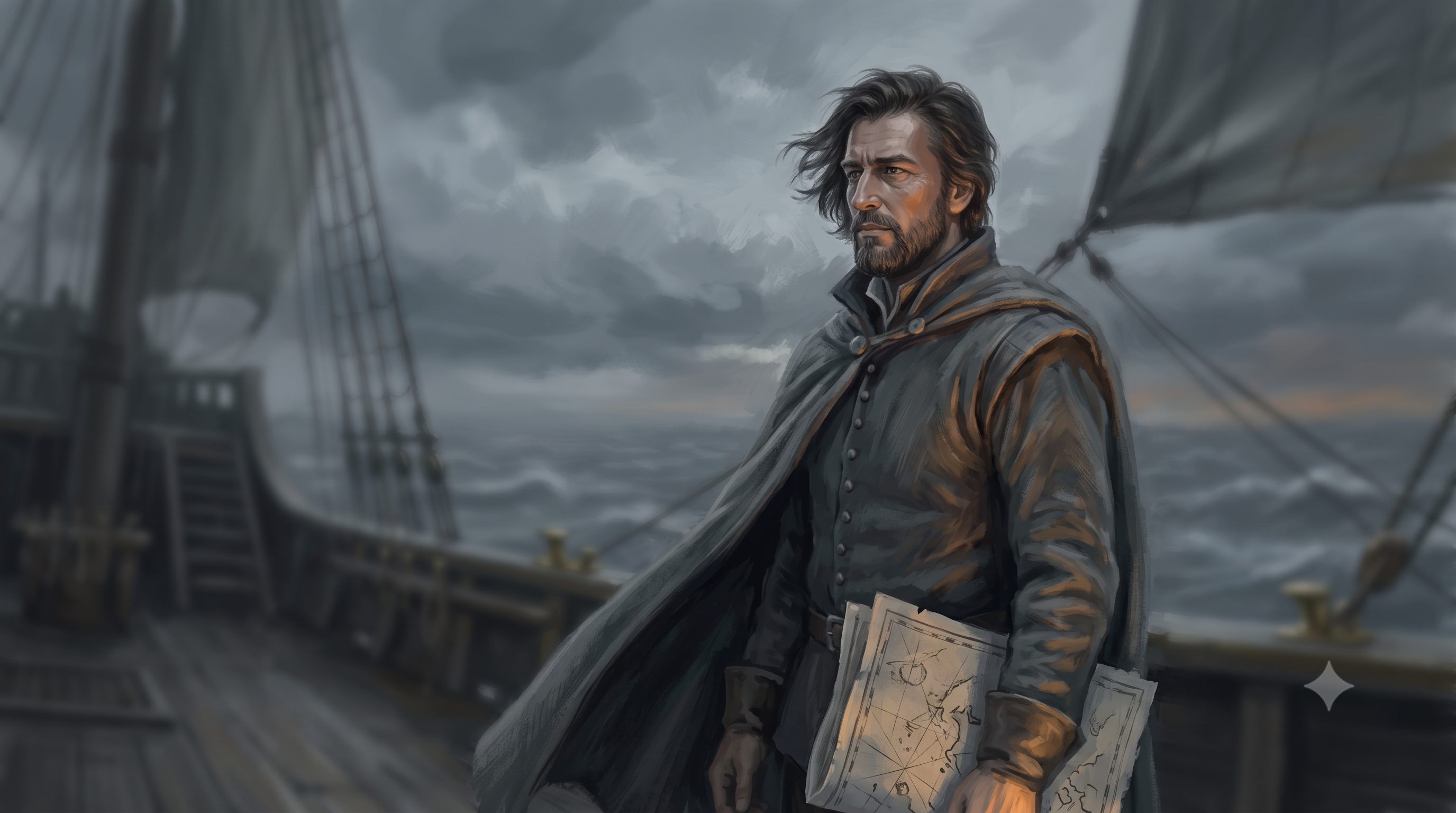
A captain and his charts, kept always within reach
Without them, he wasn't just off course — he had no way to even know it. A chart lost overboard could turn a delay into a ship never seen again.
Dead reckoning is really educated guessing, corrected occasionally by a hard measurement like a star sighting. How much of navigating your own life works the same way — moving forward on your best estimate, correcting course only when you get a clear reading?
Could you track your own location for a week using only your walking speed, your direction, and a clock — no GPS at all?
The Sandglass
Sitting right beside the lantern is a sandglass — the actual instrument dead reckoning depended on for timing. A sailor would turn it at fixed intervals through the watch and mark the ship's speed each time, since without an accurate way to measure elapsed time, there was no way to calculate distance traveled at all. Sandglasses had to be handmade, calibrated by hand, and watched constantly — no alarm, no second glass to check it against, just someone whose entire job was noticing exactly when the sand ran out.
An entire navigation system depended on someone reliably flipping a glass of sand on schedule, every single watch, for months at sea. What happens to a whole calculation if one person forgets, just once?
Could you keep accurate track of time for hours, using nothing but a sandglass you had to personally remember to flip?
The Constellation Overhead
The stars marked above him aren't decoration — a captain navigating at night needed to recognize specific patterns on sight, well enough to locate Polaris, the North Star, whose height above the horizon reveals a ship's latitude almost directly. Learning the night sky wasn't optional background knowledge for a career at sea; it was a working skill, practiced for years before anyone would trust a person with it in open water.
Before street signs, printed maps, and GPS, an entire profession depended on having the night sky fully memorized. What's something people once had to memorize as a matter of survival that almost nobody bothers learning anymore?
Could you find true north tonight using only the stars, with no compass and no phone?
The Lantern
One small lantern lights this entire scene — the only working light on a wooden ship loaded with rope, tar, and canvas sail, all of it dangerously flammable. Every open flame aboard was a calculated risk, watched constantly, because a single knocked-over lantern could end a voyage faster than any storm.
A wooden ship and an open flame were natural enemies, yet every ship carried fire anyway. What made that risk worth taking, night after night?
Could you be trusted to carry an open flame through a space every night where one mistake could burn everything down?
Two Ships on the Horizon
Two other ships sit faintly on the horizon behind him. Gosnold didn't cross alone; he captained the Godspeed as one of three ships sailing together with the Susan Constant and the Discovery, under Christopher Newport's overall command, carrying the settlers who would found Jamestown. Ships crossed oceans in company like this on purpose — for mutual aid if one broke down, defense against privateers, and simply because no single captain wanted to be the only one responsible for getting everyone across alive.
Three separate ships, three separate captains, one shared goal, crossing an ocean together with no radio to coordinate. What had to be agreed on before they ever left port, since there'd be no way to renegotiate once they were at sea?
Could you commit to a months-long plan with two other teams, knowing that once you started, there'd be no way to check in or change the plan until you all arrived?
❧
From Cross-Staff to Sextant
The first version of this illustration actually showed a sextant instead of a cross-staff — wrong for this exact moment in 1606, but not a wasted illustration. It's the instrument this story eventually grows into, a century and a half later. Worth keeping around to teach how it got there.
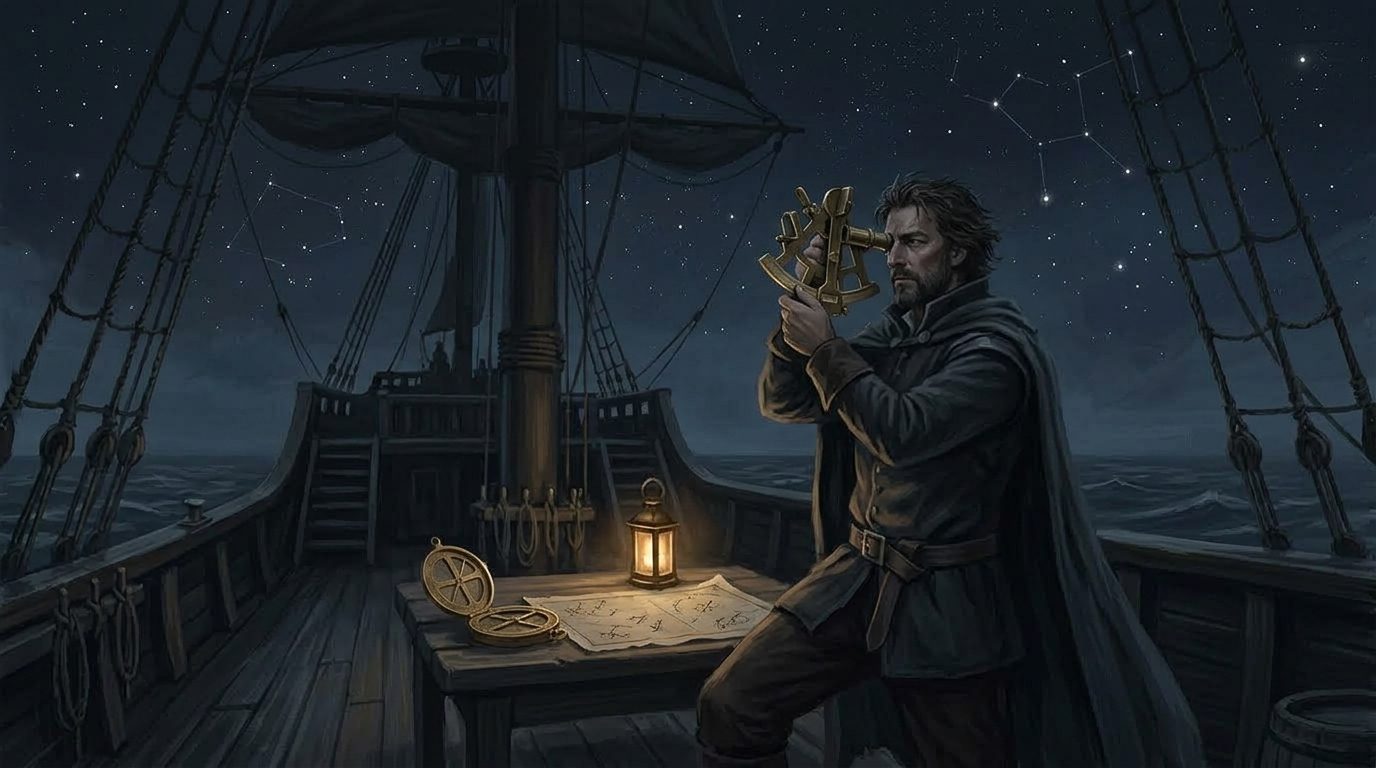
The original illustration — a sextant, roughly 150 years ahead of Plate 04's actual setting
The cross-staff had one basic flaw no amount of skill could fully fix: it needed a person to line up two separate sightlines — a star and the horizon — using nothing but a bare eye, on a deck that never stopped moving. Any small shift of the ship, or the observer's own hand, threw the reading off. It also meant staring straight at a bright star or the sun, which over years of use wore down a navigator's eyesight.
- 1594 — The BackstaffEnglish captain John Davis fixed the staring-into-the-sun problem, but only for the sun: instead of looking at it directly, the navigator read its shadow. That trick doesn't work on a star at night, so a cross-staff was still the only option after dark.
- 1731 — The OctantJohn Hadley in England and Thomas Godfrey in Philadelphia, working independently, solved the real problem: they built an instrument with two small mirrors that let a navigator see the star and the horizon at the same time, through the same eyepiece. Because both images now moved together as the ship rolled, the angle between them stayed accurate no matter how much the deck pitched — the exact flaw the cross-staff could never engineer around.
- Mid-1700s — The SextantWidening the octant's arc from 90° to 120° wasn't just a bigger number — it opened up a measurement the cross-staff and octant were never built to take: the angle between the moon and a reference star, far wider than any star-to-horizon sighting. That single change made it possible to calculate longitude at sea for the first time, solving a problem so valuable that England's Longitude Act of 1714 had offered a prize worth roughly a million of today's dollars to whoever cracked it.
Notice what actually happened here: the octant didn't just make the cross-staff's job easier — it removed a limitation nobody had thought to question, that accuracy on a moving ship required a steady hand. And the sextant didn't just improve the octant — it opened a door the octant's own inventors weren't building toward: turning a tool for latitude into a tool that could also solve longitude.
The octant didn't try to make a human hand steadier — it changed what the instrument needed a steady hand for at all. What's a problem you've tried to solve by getting better at something, when the real fix was changing what you were even trying to do?
The sextant's inventors weren't trying to solve longitude when they widened that arc — they were just building a better version of an existing tool, and it opened a door nobody had asked it to open. Have you ever built or practiced something for one reason, only to discover it let you do something else entirely?