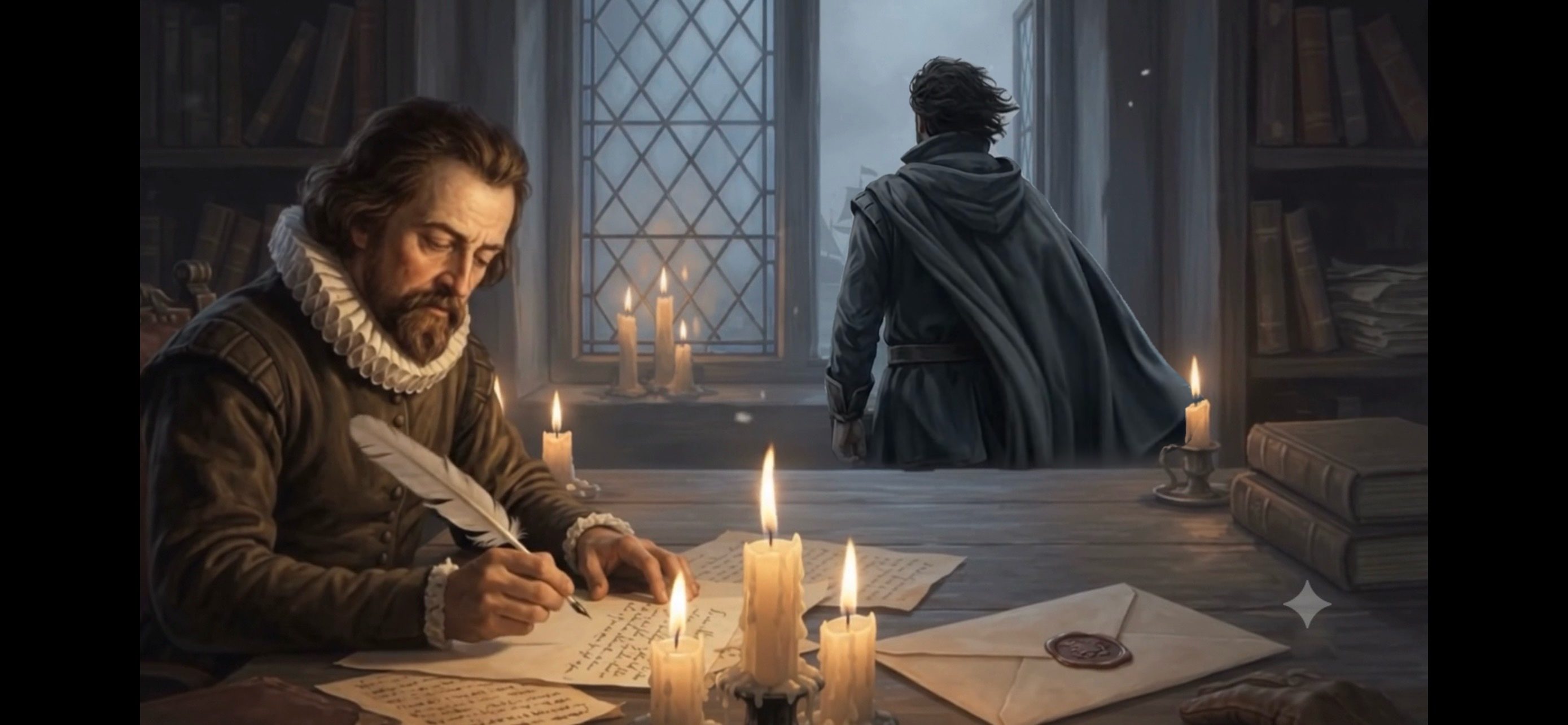
Plate 10 — Bacon at his desk, a cloaked figure departing toward the harbor
❧
Instructions Given Before the Ship Ever Left
Before the Godspeed ever cleared the harbor, everything that mattered had already been decided at a desk like this one — sealed instructions, private understandings, the exact kind of partial trust this Notebook has already named directly: a captain given enough to act, never everything anyone actually knew. Bacon's real influence over the Virginia Company worked exactly this way, through written instruction and personal correspondence rather than public command. The man walking toward that window is heading for a ship. The man still seated is the one who will never board it.
Everything this entire voyage accomplished began with a piece of paper handed over in a quiet room, long before anyone saw an ocean. What does it take to trust an instruction that far in advance, with no way to adjust it once the ship is gone?
Could you carry out someone else's instructions across an ocean, knowing you'd have no way to ask a follow-up question once you were underway?
The Man Who Never Saw Any of It
Bacon never crossed the Atlantic. He never saw Jamestown's cliffs, never stood inside the fort this Notebook has already walked through, never met the men who actually built it. Everything he contributed to this entire voyage — the strategy, the influence, the vision of an institution built to outlast any single founder — happened entirely from rooms exactly like this one, an ocean away from every consequence of it.
Bacon shaped a colony he would never personally set foot in. Can someone genuinely be called a founder of something they never physically saw?
Could you commit years of effort to a project whose actual results you might never get to witness firsthand?
A Man Genuinely Trained in Secrets
Whatever else the Hidden Hand represents, Bacon's own documented career needs no embellishment to earn it. By 1607 — the same year Gosnold sailed for Virginia — Bacon had already been made Solicitor-General, an office answering directly to the Crown. He became Attorney-General in 1613, a Privy Councillor in 1616 (a seat inside the monarch's own innermost circle of advisors), and Lord Chancellor by 1618 — real positions that put him in direct, routine contact with state secrets, diplomatic correspondence, and the machinery of the Crown itself. He was also, quite literally, a trained cryptographer: around 1605 he devised what's now called the Baconian cipher, a genuine method for hiding a message inside ordinary-looking text by alternating between two subtly different type styles, which he published openly himself in his 1623 book De Augmentis Scientiarum. None of this is legend. It's his actual, documented career.
A statesman with genuine access to Crown secrets and a real, working cipher of his own invention is a very different kind of "hidden hand" than a purely invented legend would be. Does knowing the real biography behind a mystery make it more compelling to you, or less?
Could you hold real state secrets in one hand and a private, personal mission in the other, keeping both perfectly separate for an entire career?
❧
Word Arrives, Already Old News
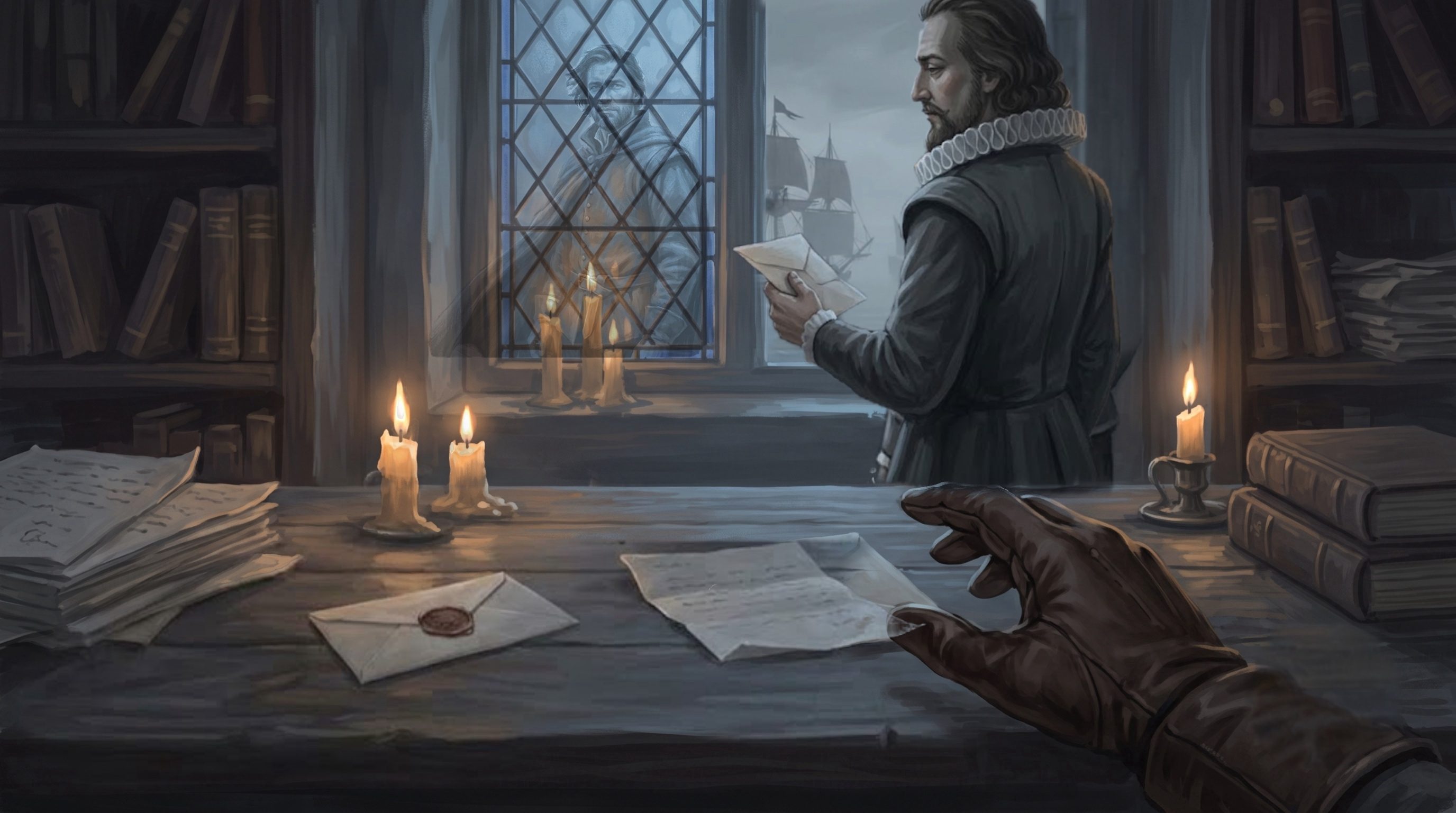
The letter arrives. By the time it does, everything in it has already happened.
Gosnold died on August 22, 1607. Word of it could not have reached London for weeks, possibly months — carried the same slow way every letter in this Notebook has traveled, sealed in wax, entrusted to whichever ship happened to be sailing home next. By the time Bacon actually read this news, it was already old. He wasn't learning that Gosnold had died. He was learning that Gosnold had been dead for some time, and there had been nothing anyone in London could have done about it regardless.
News this important still took weeks to arrive, and there was no way to speed it up no matter who you were or how much it mattered. How do you think it changes grief, to learn about a loss that already happened a long time ago?
Could you accept news about someone you cared about, knowing it was already old by the time it reached you, and there had never been any way to arrive sooner?
Look Again: The Man in the Glass
Look at the window behind Bacon closely, and a second figure is faintly visible in the glass — the same cloaked man from the departure scene, now present only as a trace, half-transparent, more memory than person. Nothing in the room actually explains this presence; it isn't a visitor, and no one else in the scene reacts to it. It's a deliberate visual choice representing something the caption already told you in words: that the man behind that news is now gone, and only the impression of him remains.
The artist chose to show a memory as a literal, half-visible presence rather than leaving him out of the frame entirely. What does keeping him faintly there, instead of simply absent, communicate that an empty window wouldn't?
Could you notice a detail like this on your own, without anyone pointing it out, the next time you look closely at a painting or photograph?
Look Again: The Hidden Hand
A gloved hand reaches into the frame from the edge, taking hold of the letter on the desk. No face, no name, nothing identifying whoever it belongs to — the same anonymous presence that has quietly carried Bacon's private correspondence throughout this entire story, always active, always mid-motion, never resting. It isn't meant to represent one specific person. It represents the part of this whole enterprise that kept moving forward no matter who lived, who died, or who never got to see the outcome at all.
This hand has appeared, unnamed, throughout this entire Notebook without ever being explained until now. Why do you think withholding its meaning until the very end made it more effective, rather than less?
Could you do essential, ongoing work for something bigger than yourself, knowing you would personally get no name and no credit for any of it?
What Actually Outlived Everyone
Line up everything this Notebook has already covered and a single pattern runs through all of it. Gosnold died three months after landing and never saw the colony survive its first year. Bacon never crossed the ocean and never saw any of it firsthand. The fort itself — the actual physical structure — didn't even survive the centuries that followed; it vanished so completely that historians assumed the river had swallowed it, until someone in 1994 refused to accept that and found it anyway. Not one person at the center of this story got to witness what it became. The idea kept moving regardless — carried forward, letter by letter, decision by decision, by hands that were rarely the ones who'd started it.
Every individual person in this entire story is gone, and yet something they built is still being taught, studied, and talked about right now, in this very lesson. What does it actually mean for something to "outlive" the people who made it?
Could you build something on purpose designed to keep going without you — something that wouldn't need you personally to survive?
He Never Saw — But the Frame Still Stands
Neither Gosnold nor Bacon lived to see whether any of this actually worked. Gosnold didn't survive the first summer. Bacon never left England at all. And still — the colony held, the Company continued, the idea of an English foothold in America outlasted every single person who first tried to build it, including the two men closest to its beginning. That's the whole shape of this story, laid bare in one closing image: he never saw it. The frame still stands anyway.
This entire Notebook has quietly been building toward this one idea, one Element at a time, without saying it outright until now. Looking back, where do you think you first started noticing it, even before this Plate named it directly?
Could you spend your effort on something you were genuinely certain would outlast you, even knowing you'd never get to see how the story actually ends?