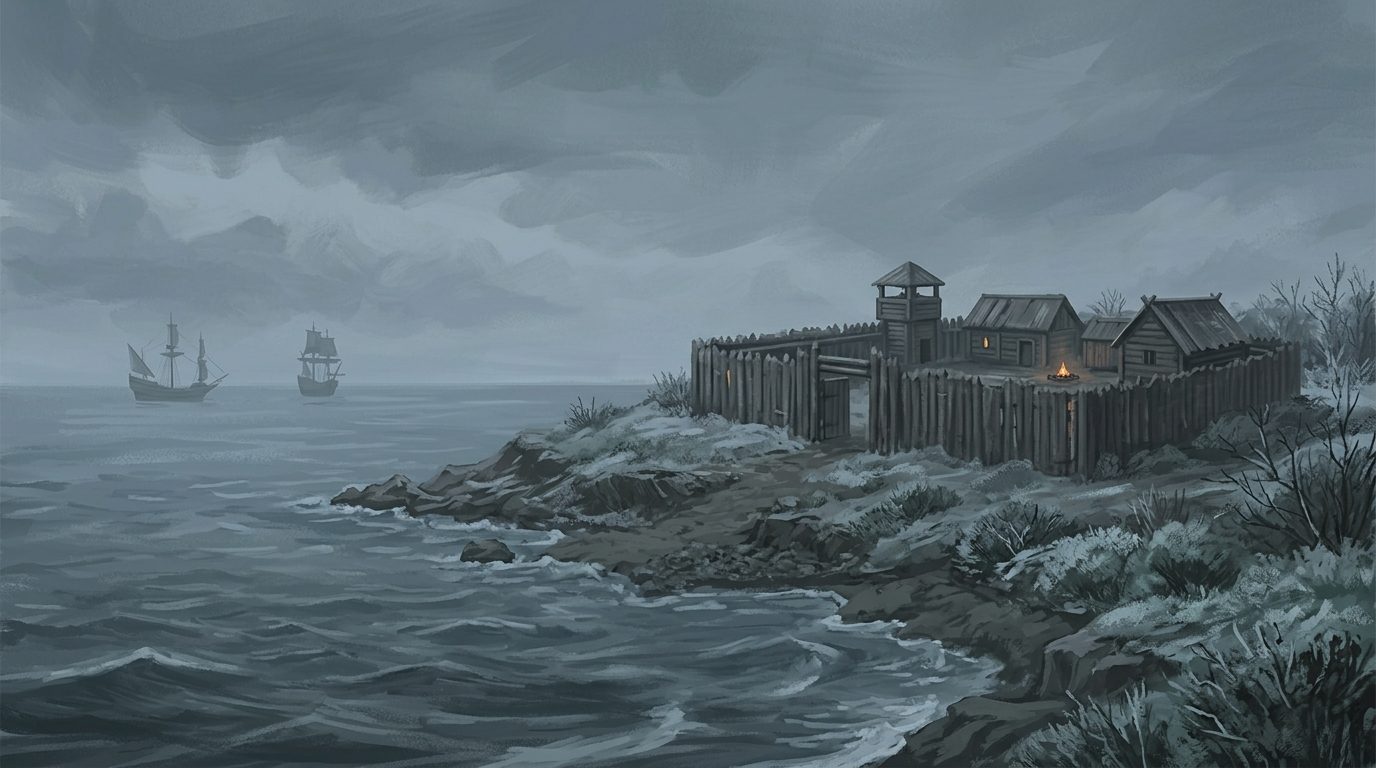
Plate 09 — the fort on the peninsula, ships anchored offshore
❧
Why This Exact Spot?
Newport spent 17 days exploring the James River before choosing this exact site, and the Virginia Company's own written instructions explain why the search took that long: they wanted a "safe port in the entrance of some navigable river, making choice of such a one as runneth furthest into the land." Jamestown checked every box on their list. The water ran deep right up to the shore, so ships could tie directly to trees on the bank instead of anchoring far out. It sat on a peninsula, nearly cut off by water, making it far harder for anyone to attack overland. And it happened to be land Chief Powhatan used only for hunting, not a village — meaning the English could settle it without directly displacing anyone.
Every one of these reasons was genuinely smart military and logistical thinking. What do you think the colonists were not checking for, while they were busy checking for all of this?
If you had to pick a place to build a permanent home in genuinely hostile, unfamiliar territory, what would you prioritize first — safety, or livability?
Built by Hand, in About a Month
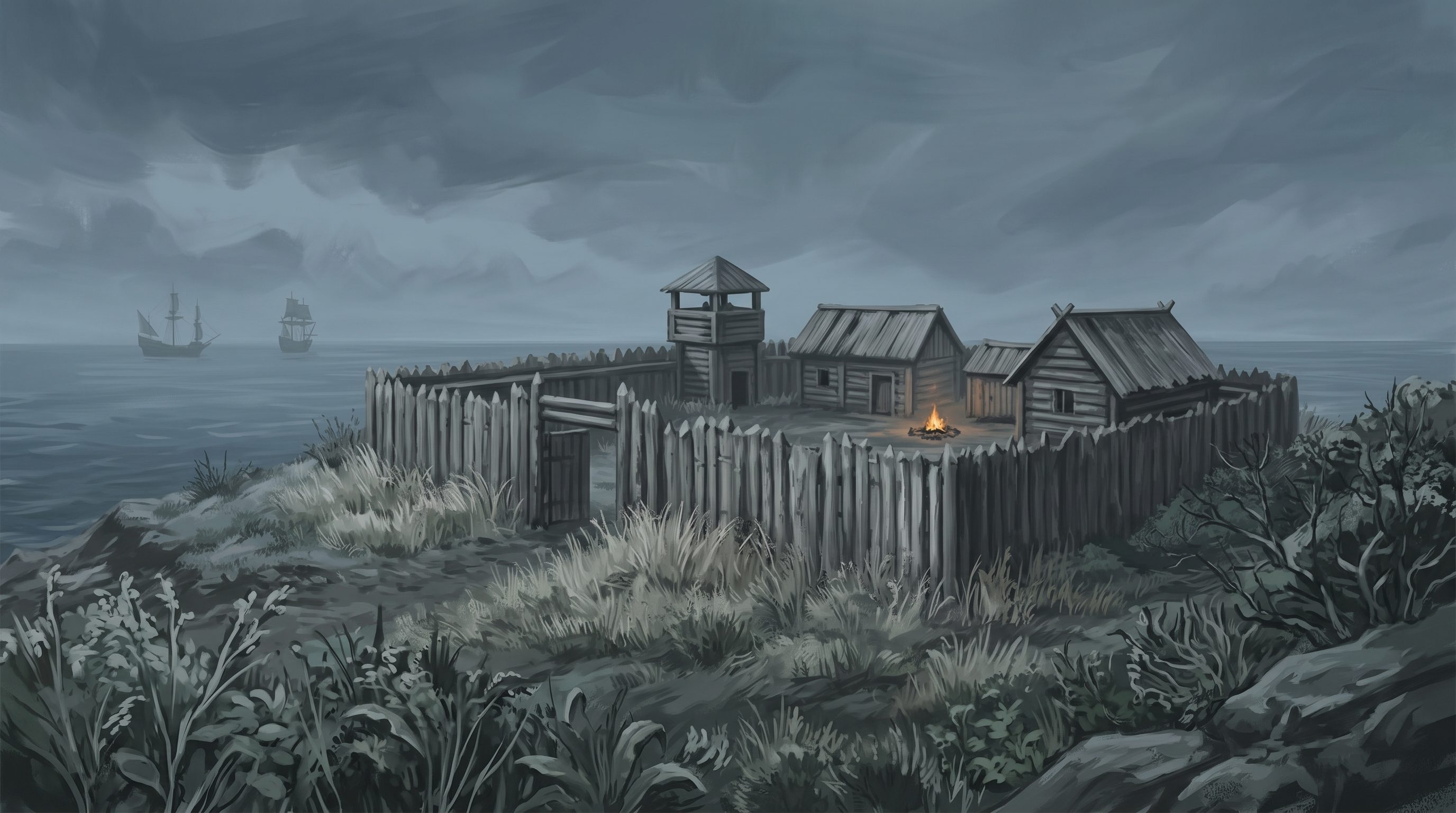
Palisade, watchtower, and gate — built entirely with hand tools and felled local timber
The real James Fort was completed only about a month after the settlers landed, using nothing but hand tools, local timber, and the skills already covered in this Notebook — shipwrights and carpenters swinging axes instead of building hulls, ropemakers' knowledge applied to lashing and hauling logs into place. Archaeological digs confirm its actual shape was a triangle, not a rectangle, with a bulwark — a raised, reinforced platform for mounting cannon — anchoring each of its three corners, so the fort's own guns could cover every approach at once.
A month to raise a working defensive fort from raw timber, with no crane, no powered tools, and no prior structure to build from. What do you think made that speed possible?
Could you help build your own shelter, from nothing but standing trees, in under a month, knowing your safety depended on finishing it?
The Same Choice That Doomed It
The exact features that made this site defensible are what made it nearly uninhabitable. The peninsula's marshy, low ground bred mosquitoes carrying malaria. The same river that ran deep enough for ships also ran brackish — tidal saltwater mixing with fresh — meaning the settlers' main drinking water was slowly poisoning them, especially once it mixed with their own waste. Archaeologist William Kelso, who led the dig that rediscovered the fort's true footprint in 1994, has described the site plainly as a mix of practical necessity and strategic miscalculation. It genuinely was the smart military choice. It also came within a hair of ending the entire colony before it began.
The same decision was simultaneously the right call and a near-fatal mistake, depending on which problem you were solving for. Can a choice be genuinely correct and genuinely catastrophic at the same time?
Could you keep trusting a decision you made, once you started seeing real evidence it might be slowly killing you?
What Was Actually Available
Timber was abundant and free — the one resource the site had no shortage of, which is exactly why the fort itself went up so fast. Almost everything else had to come from a ship or from trade. The soil was poor for the crops the settlers actually knew how to grow, the water needed constant management, and there was no reliable local food source the colonists could access on their own — meaning survival depended heavily on trade with the Powhatan Confederacy, and later, resupply voyages arriving from England on schedules no one on the ground could control.
The colony had exactly one resource in genuine surplus and depended on outside sources for almost everything else. How do you think that imbalance shaped every other decision they made?
Could you build a life somewhere with abundant building material but almost no reliable food source of your own?
The Real Failures, Named Plainly
Beyond the site itself, real documented mistakes compounded the danger. A meaningful number of the original colonists were gentlemen with no practical trade, some more focused on searching for gold than growing food or reinforcing the fort — a problem serious enough that John Smith later imposed a blunt rule on the colony: those who wouldn't work wouldn't eat. Leadership itself was unstable in the early months, with real infighting inside the governing council. None of this caused the swamp or the brackish water, but it meant the colony had less capacity to absorb those problems than it needed.
Some of the colony's problems came from its location and couldn't have been avoided. Others came from decisions people made and genuinely could have gone differently. Why does it matter to keep those two categories separate when judging what happened here?
Could you do genuinely unglamorous, essential labor — farming, building, hauling — when searching for treasure felt like the more exciting option?
Look Again: The Gate Has Only One Way In
Easy to glance past: there's exactly one visible gate into this entire fort, set into an otherwise unbroken wall of sharpened logs. That's not an oversight — a single controlled entrance meant everyone and everything moving in or out passed a chokepoint the defenders could watch, close, or defend far more easily than an open perimeter. The watchtower rising above the gate wasn't decoration either; it gave a sightline over the water and the surrounding land that no one standing at ground level inside the walls could get.
A single controlled entrance is safer to defend but also slower and more restrictive for everyday life. Where else do you see that same trade-off — more security bought at the cost of convenience?
Could you live somewhere your daily movement was deliberately funneled through one watched point, for your own protection?
Look Again: A Fire Still Burning Inside
Small in the frame, easy to overlook: a fire burns in the open space at the center of the fort, right beside the houses rather than tucked away from them. After everything this Notebook has already covered about fire's danger aboard a wooden ship, seeing one kept deliberately alight inside a settlement built entirely from the same flammable timber says something — this was a controlled, managed risk the colonists judged worth taking every single day, for cooking, warmth, and light, not a hazard they could simply choose to avoid.
A wooden fort and an open flame are exactly the same conflict this Notebook already covered at sea — just moved onto land. What made this particular risk one people accepted without a second thought?
Could you live comfortably beside a daily risk you'd fully accepted, rather than staying anxious about it?
A Fort That Had to Be Found Again
For most of the 20th century, historians assumed the original fort had simply been swallowed by the river, eroded away over three centuries with nothing left to find. In 1994, archaeologist William Kelso ignored that consensus and started digging anyway — and found the fort's actual triangular footprint still intact, exactly where the written accounts said it should be. The physical fort in this illustration didn't survive the way a stone building might have. It disappeared for nearly 400 years, and the only reason we can describe it this precisely today is because someone refused to accept it was gone for good.
The fort itself vanished completely, and yet everything it represented — the colony, the written accounts, the fact of this place — survived anyway. What's the difference between a structure surviving and what that structure stood for surviving?
Could you keep believing something real was still there to find, after everyone else had already decided it was gone?