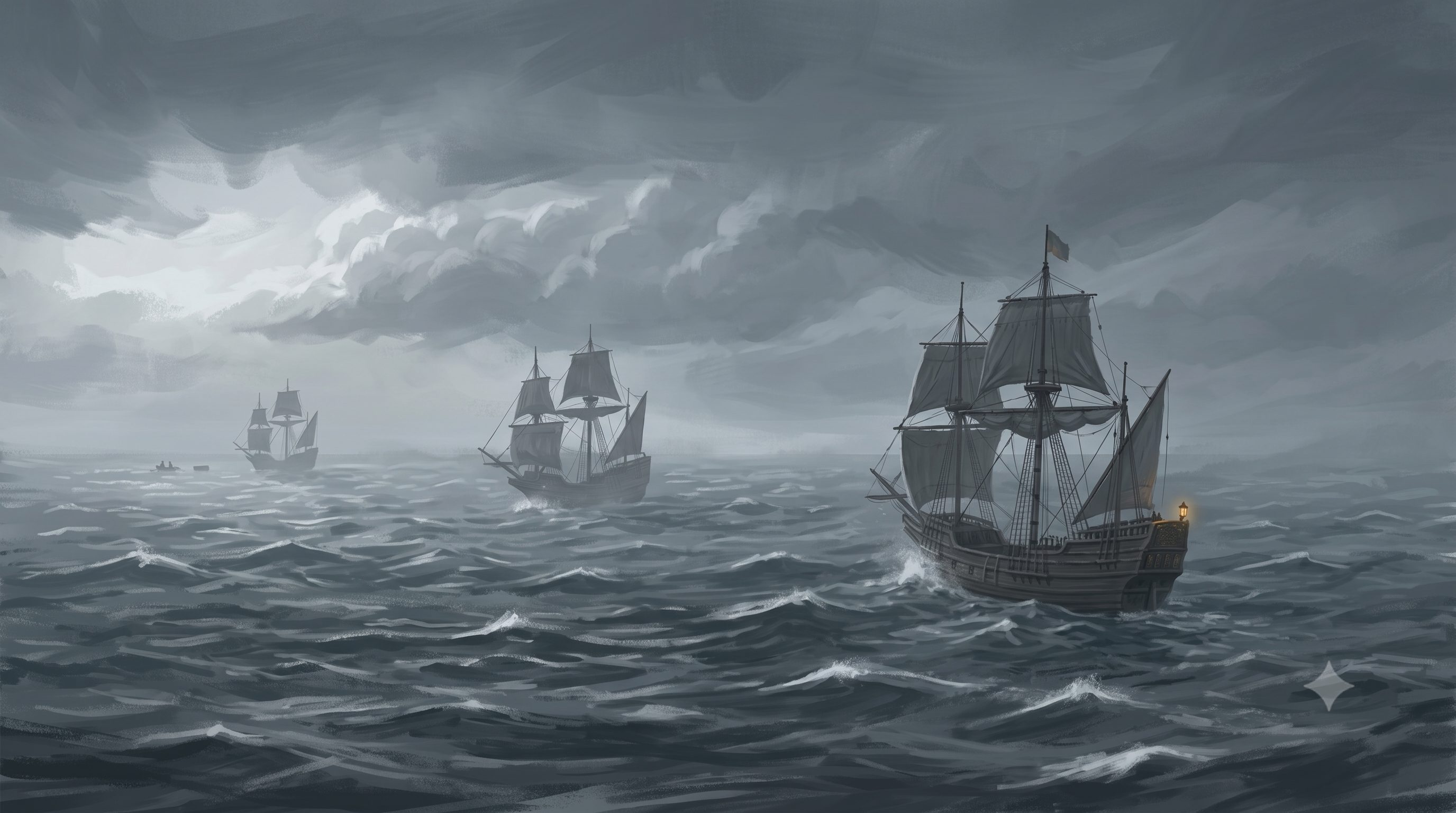
Plate 05 — three ships crossing open water under a heavy sky
❧
The Ship as Cargo Hold
By this era, ocean shipping moved goods no overland route could match — silver, spices, sugar, tobacco, cloth — crossing entire oceans in a single voyage. One hull like these could carry what would otherwise take hundreds of pack animals and weeks of overland travel, at a fraction of the cost per pound. That efficiency is exactly why entire companies, fortunes, and empires organized themselves around who controlled which ships.
Merchants pooled money into shared ventures specifically because a single ship's cargo could be worth a fortune, and a single storm could erase it completely. Why would spreading the risk across many investors make sense for something this dangerous?
Could you put your life's savings into a venture that might return ten times what you put in — or vanish at sea and return nothing at all?
The Storm With No Warning
With no forecasting of any kind, a storm like the one gathering in this sky announced itself only when it arrived. The Spanish treasure galleon Nuestra Señora de Atocha is a real example of exactly what could go wrong: caught by a hurricane in 1622 and driven onto a reef off the Florida Keys, only 5 of the 265 people aboard survived.
Every captain making a crossing like this one knew that a real percentage of ships attempting it simply never arrived — no message, no wreckage, no explanation ever reaching the families waiting. How do you think people made peace with sending someone on a voyage under those odds?
Could you board a ship knowing there was a real, openly acknowledged chance it would never be seen again?
Pirates, Privateers, and a Piece of Paper
A pirate and a privateer could do the exact same thing at sea — chase down another ship, board it, and take its cargo — with one difference deciding which word applied: a privateer carried a government-issued letter of marque, making the raid legal in the eyes of their own crown. Christopher Newport, who commanded the Susan Constant on the very voyage that founded Jamestown, had spent years as an English privateer before that command, legally raiding Spanish shipping and losing an arm in the process.
Newport's role in the colony didn't end at the Virginia coastline. He made five separate crossings to Jamestown between 1606 and 1612, keeping the struggling settlement resupplied through its worst years — including the return after the "Starving Time" of 1609–10, when colonists abandoning Jamestown met his relief ships on the James River and turned back. That meeting point is very likely why the city there is called Newport News today: colonists watching for his ships were watching for Newport's news. Between the two captains who made the 1607 voyage possible, Newport's fingerprints on the colony's actual survival may run every bit as deep as Gosnold's — even though it's Gosnold's name this whole series has been telling.
The captain trusted to carry the Jamestown settlers safely across the Atlantic had built his reputation raiding other ships. What does that say about what "trustworthy" actually meant in this era?
Privateering as a formal license didn't survive — the major naval powers renounced it outright in the 1856 Declaration of Paris, and even the United States, which never signed that treaty, hasn't issued a letter of marque since the War of 1812, though Congress technically still holds the constitutional power to (Article I, Section 8). What didn't disappear is the underlying arrangement: a government authorizing violence carried out by parties with a direct financial stake in the outcome. Retired Marine Corps Major General Smedley Butler — a two-time Medal of Honor recipient — argued exactly this in his 1935 book War Is a Racket, drawing on his own 34-year military career to claim that modern wars are often fought to protect business and financial interests dressed up as national necessity.
The closest modern descendant isn't quite the mercenary, though the two get confused. International law actually treats them as opposites: a 1977 addition to the Geneva Conventions (and a 1989 UN treaty built on it) strips legal combatant protections specifically from mercenaries — fighters with no national stake in the conflict, hired by anyone willing to pay. A privateer was never that; a privateer was a private citizen commissioned by their own government to attack that government's declared enemies, profit-driven but still tied to a national cause. Modern private military contractors are built the same way — framed as security, logistics, or training rather than combat — specifically to stay on the legal side of that same line. The privateer's real heir kept the flag; only the pure mercenary ever dropped it.
Could you tell the difference between a lawful act and an unlawful one if the only thing separating them was a piece of paper issued by whichever government you happened to serve?
Building a Hull to Survive the Ocean
Ships like these were carvel-built: planks laid edge to edge over an internal skeleton of ribs, rather than the older style of overlapping planks with no internal frame. That skeleton let shipwrights build bigger, stronger hulls that could carry heavier cargo and heavier guns without the sides working loose in rough seas. The shift from a single mast to three masts, seen on all three ships here, mattered just as much: losing one sail or spar in a storm no longer meant losing control of the entire ship.
Three masts instead of one is a form of redundancy — a backup built into the design before anything even breaks. Where else might building in a backup matter more than building the strongest possible single version of something?
Could you trust your life to a wooden hull held together by joinery, rope, and tar, in open ocean, with no way to call for help if it began to fail?
Cannon and the Broadside
The first cannon carried aboard ships date back to around 1304, small pieces mounted on the forecastle for close fighting. The real turning point came around 1501, when shipwrights began cutting gunports directly into the hull — openings that let much heavier cannon sit low and stable along the sides rather than crowded on deck. That single change made it possible, for the first time, to fire an entire volley from one side of a ship at once: a broadside, the tactic that defined naval warfare for the next three centuries.
Cutting gunports meant cutting holes in the exact structure whose whole job was keeping the ocean out. What does it take to accept a real weakness in a design because of what it makes possible?
Could you serve as a ship's gunner, loading and firing a cannon on a rolling deck, knowing a mistake could hurt your own crew as easily as the enemy?
What Happens to a Ship That Doesn't Come Home
The Atocha sank carrying roughly 40 tons of gold and silver and a fortune in emeralds, and stayed lost for over 350 years. Treasure hunter Mel Fisher searched for it for 16 years before his team finally located the wreck in 1985 — a find eventually valued at around $400 million. Modern treasure hunting depends on real technology, magnetometers and sonar to detect scattered metal across miles of seafloor, and real law, since Fisher had to fight the State of Florida all the way to the Supreme Court to keep what he found.
A ship that sinks doesn't just disappear — its cargo can still be found, argued over, and recovered centuries later. What does that suggest about how permanent "lost" really is?
Could you spend sixteen years of your life searching for something you had no proof you would ever actually find?
Everyone It Took to Build One Ship
A single ship like these took dozens of separate trades working together over months. Shipwrights framed the hull and caulkers sealed every seam against the sea. Sailmakers cut canvas by hand, and ropemakers didn't just twist rope — they soaked and coated it in tar to keep saltwater and rot from destroying it within weeks of leaving port. An anchorsmith forged the ship's iron anchor as a single piece that could weigh well over a thousand pounds, in a specialized forge built to handle metal at that scale. Coopers built every barrel aboard — and a ship like this needed dozens, since barrels were the only way to store fresh water, salted meat, beer, and gunpowder without it spoiling or spilling; a badly made barrel could ruin a voyage as surely as a storm. And once the ship was loaded and underway, a cook still had to feed the entire crew out of a cramped galley, mostly on salted meat and hard ship's biscuit meant to last months at sea without fresh food.
Every one of those trades had to agree on the same measurements and timing for their separate pieces to fit together correctly. What has to be true about a group of specialists, none of whom may report to each other, for that kind of coordination to work at all?
Of all the trades that went into building and provisioning a ship like this, which one do you think you'd actually be good at?
Three Problems, Solved Slowly, Together
Getting a ship like this home safely depended on three separate lines of innovation stacking on top of each other over generations: knowing where you actually were, building a hull that could survive the ocean itself, and being able to defend the ship from other people. None of these were solved once and finished — each was improved a little further with every generation of shipwrights, captains, and gunners, so that a ship built in 1607 was already safer than one built fifty years earlier, without anyone involved seeing the whole improvement happen in their own lifetime.
Nobody alive when these three ships were built had personally solved navigation, shipbuilding, and naval defense — they'd each inherited partial solutions and improved them slightly before passing them on. What are you currently improving that you'll likely hand off unfinished to someone else?
Could you dedicate real effort to making something better, knowing you'd probably never see it become as good as it eventually could be?