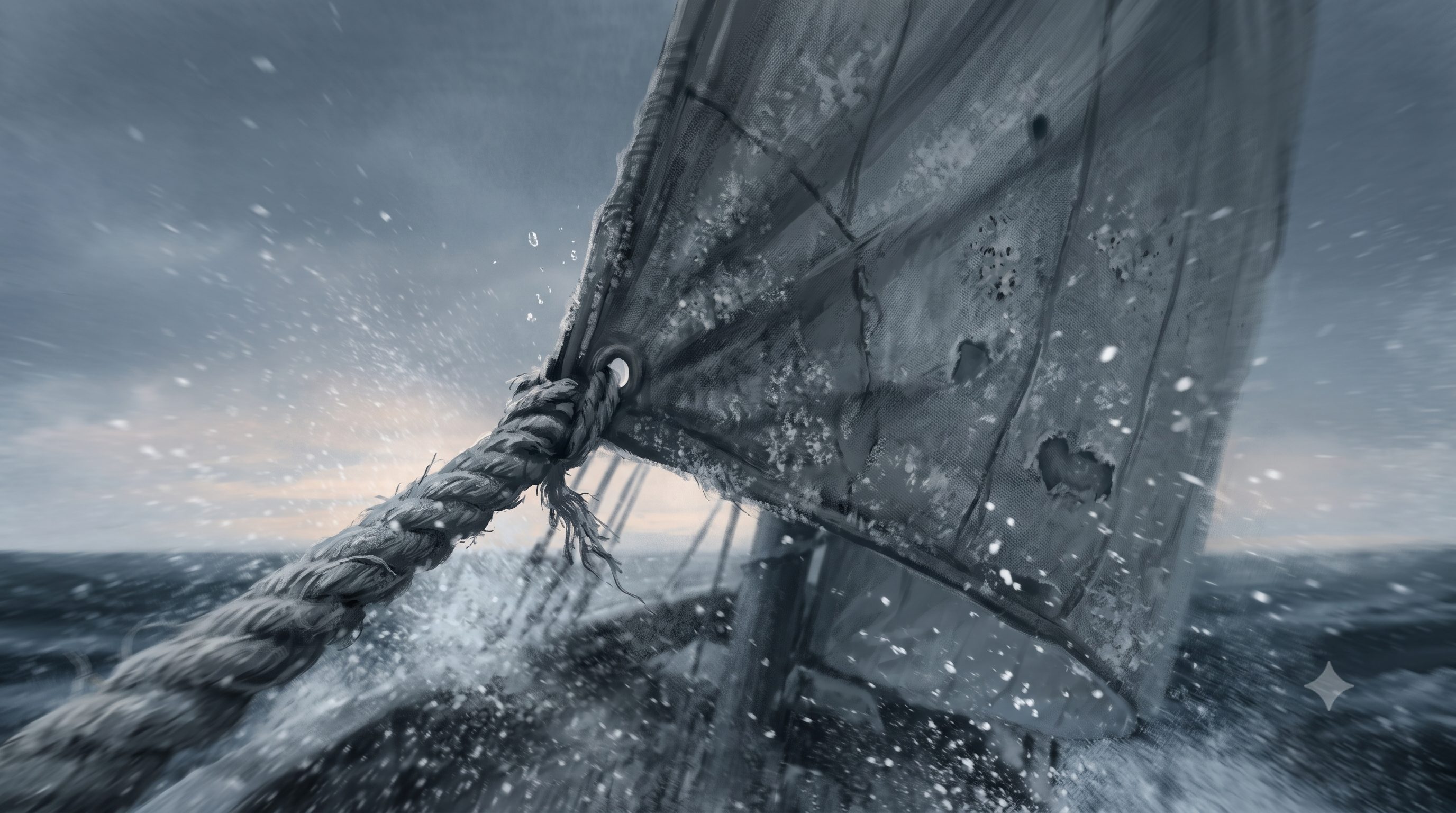
Plate 06 — a rope under full strain, lashed to a wind-driven sail
❧
What Rigging Actually Does
The rope in this image is doing two jobs rigging always does: holding the mast itself upright against enormous sideways force, and controlling the exact shape and angle of the sail so it catches wind instead of just flapping uselessly. Without rigging, a mast and a sail are just wood and cloth. With it, they become a machine for turning wind into forward motion — and every part of that machine is under constant, serious tension.
A sail alone can't do anything useful — it needs an entire system of ropes to actually work. What other tools can you think of where the "real" invention is really a system, not a single object?
Could you learn to read a whole system of ropes well enough to know, at a glance, which one was in danger of failing?
From One Square Sail to a Web of Lines
Viking ships sailed with a single mast and a single square sail, controlled by a fairly simple set of lines — effective for running with the wind, but poor at sailing across it or against it. By the time ships like the one in this scene were built, rigging had grown into a genuinely complex system: three masts, a mix of square sails for raw power and triangular lateen sails (adapted from Mediterranean and Arab sailors) for steering closer into the wind, each one needing its own set of ropes to raise, lower, and angle it.
Going from one simple sail to a mixed system of several sail shapes made ships far more capable — and far more complicated to operate. What's a tool or system in your own life that got more powerful specifically by getting more complicated?
Could you memorize which of a dozen different ropes controlled which sail, well enough to grab the right one in a sudden storm?
Standing Rigging, Running Rigging, and the Rope Itself
Rigging split into two very different jobs, and rope had to be made differently for each. Standing rigging held the masts in place and was meant to barely move at all once set — heavily tarred hemp rope, built to resist stretching and rot for months at sea. Running rigging did the opposite job: sliding constantly through blocks and pulleys to raise sails and adjust their angle, so it had to stay flexible and resist wearing through from friction, not just weather.
None of this was calculated the way an engineer would calculate it today — there was no testing machine, no measured breaking strength. Rope was sized entirely by proportion: every line on a ship was built as a known fraction of the main mast's own diameter, a ratio carried in a ropemaker's trained memory rather than on paper. The main stay was roughly a sixth of the mast's thickness; everything else was sized down from there. Thickness itself came from strand count, and each count had a name and a job. Three strands twisted together made hawser-laid rope — the standard-duty line, used everywhere general strength was needed. Four strands made shroud-laid rope, heavier-duty, reserved for the standing rigging holding the mast itself. For the very heaviest loads, like an anchor cable, ropemakers laid several finished ropes together into cable-laid rope — a rope built out of ropes. Choosing a thicker line was never a fresh judgment call; it meant reaching for the next known category up.
The real testing happened at sea, not in a workshop — across entire fleets, over years. A rope that held became the new standard; one that failed in a storm meant the next one was built a size heavier. And the two kinds of rigging weren't tested against the same danger. Running rigging only had to survive whatever a crew's arms and a capstan could physically pull — a real, human-limited ceiling. Standing rigging had no ceiling at all: it had to survive raw wind and wave force with no machine involved, which is exactly why it was built so far oversized — not calculated to the load, but oversized against the worst storm anyone had ever seen, plus a margin for the one they hadn't. England's own royal ropeyards at Woolwich (established 1573) and Chatham (1567) were scaling up to supply exactly this kind of rope in the very decades this scene takes place.
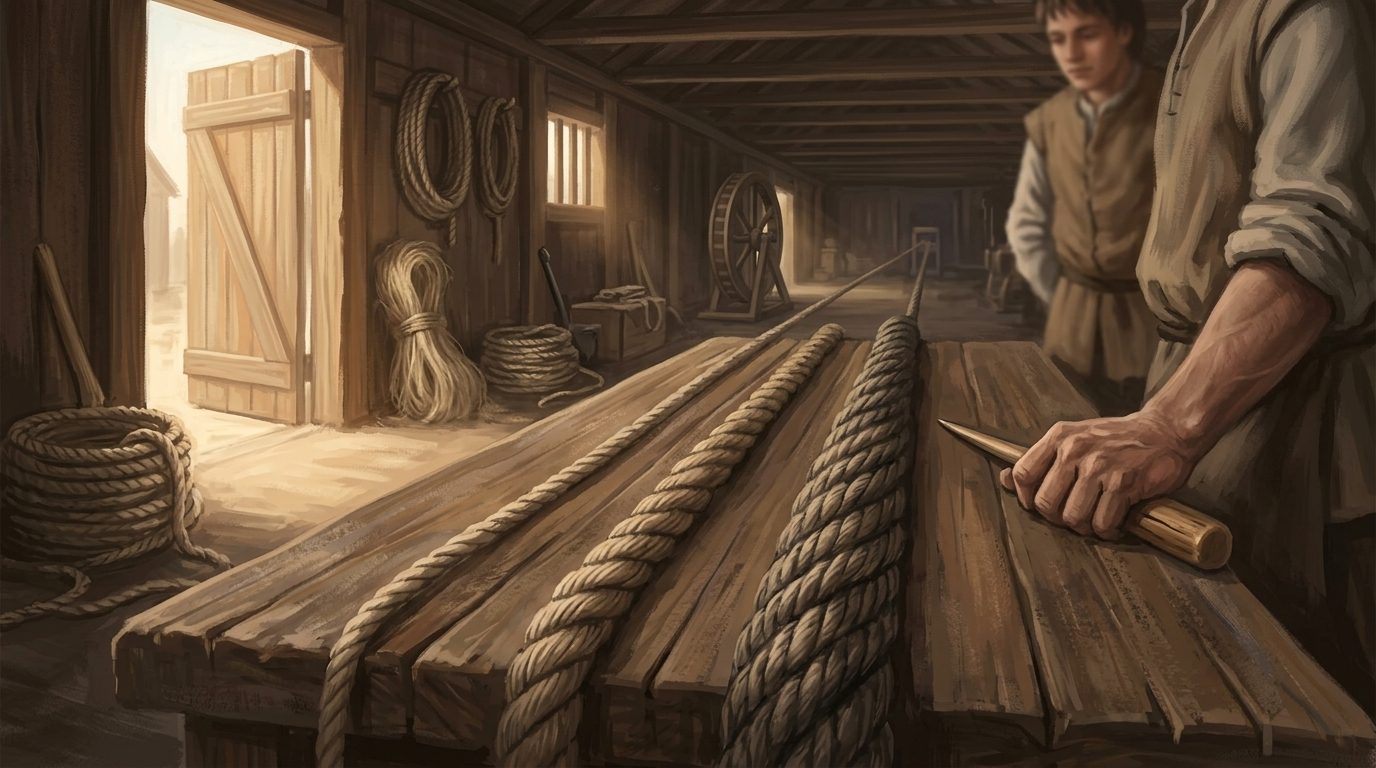
Hawser-laid, shroud-laid, and cable-laid rope, laid out side by side
The same raw material — rope — had to be engineered two completely different ways depending on its job. Where else does the exact same basic material need totally different treatment depending on what it's being used for?
Nobody calculated a breaking strength — the whole fleet, over years, ran the experiment instead, and the surviving ratio became the standard. Where else do you see a "standard" that was really just whatever survived long enough to become one?
Could you tell, just by looking at or handling a rope, whether it was built to stay still or built to move?
When a Line Lets Go
A rope under this much tension doesn't just go slack when it fails — it snaps back with enough force to seriously injure or kill anyone standing in its path. Losing a single line in a storm could mean losing control of an entire sail at the worst possible moment, and losing the wrong one could bring down a mast entirely, disabling the ship and endangering everyone still working the rigging above deck.
A single point of failure — one rope — could disable an entire ship. Where do you see that same kind of single-point risk in systems you rely on today?
Could you keep working calmly next to something that could kill you instantly if it failed, for hours at a time, day after day?
The Men Who Worked Aloft
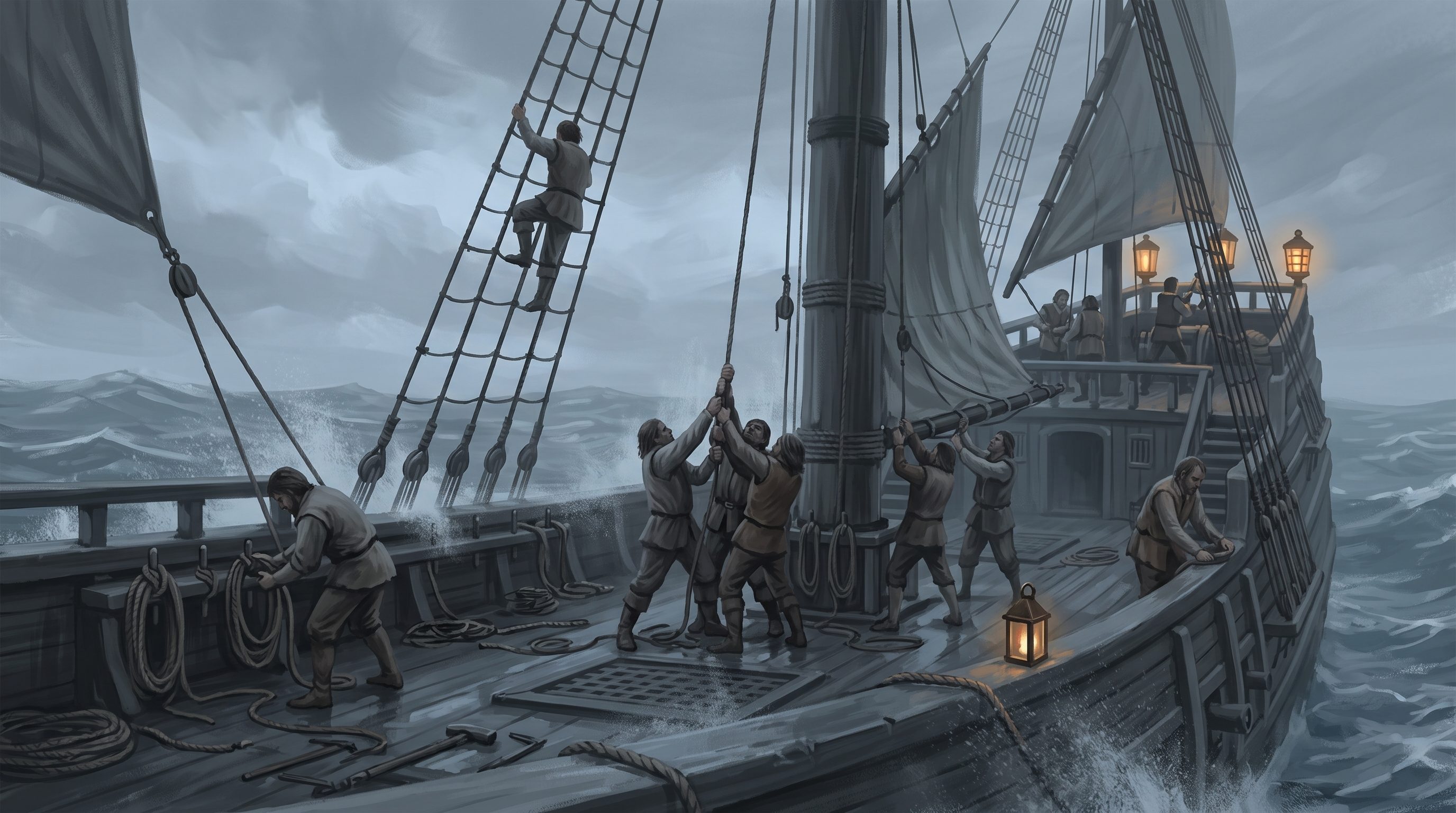
A crew hauling together, one man already on the rigging ladder
Handling rigging took real strength — several men hauling the same rope at once was normal, not a sign anything had gone wrong — but strength alone wasn't enough. Someone had to climb the rigging itself, often dozens of feet above a rolling, pitching deck, to work on a sail directly. That climb had to happen in daylight or darkness, calm weather or a storm, with nothing but the rigging itself to hold onto.
This job needed strength, balance, and a real tolerance for genuine danger, all at once. What modern jobs still demand that same combination today?
Could you climb 60 feet of rope ladder on a rolling ship, at night, in bad weather, because the job simply required it?
Rigging for Calm Water, Rigging for a Storm
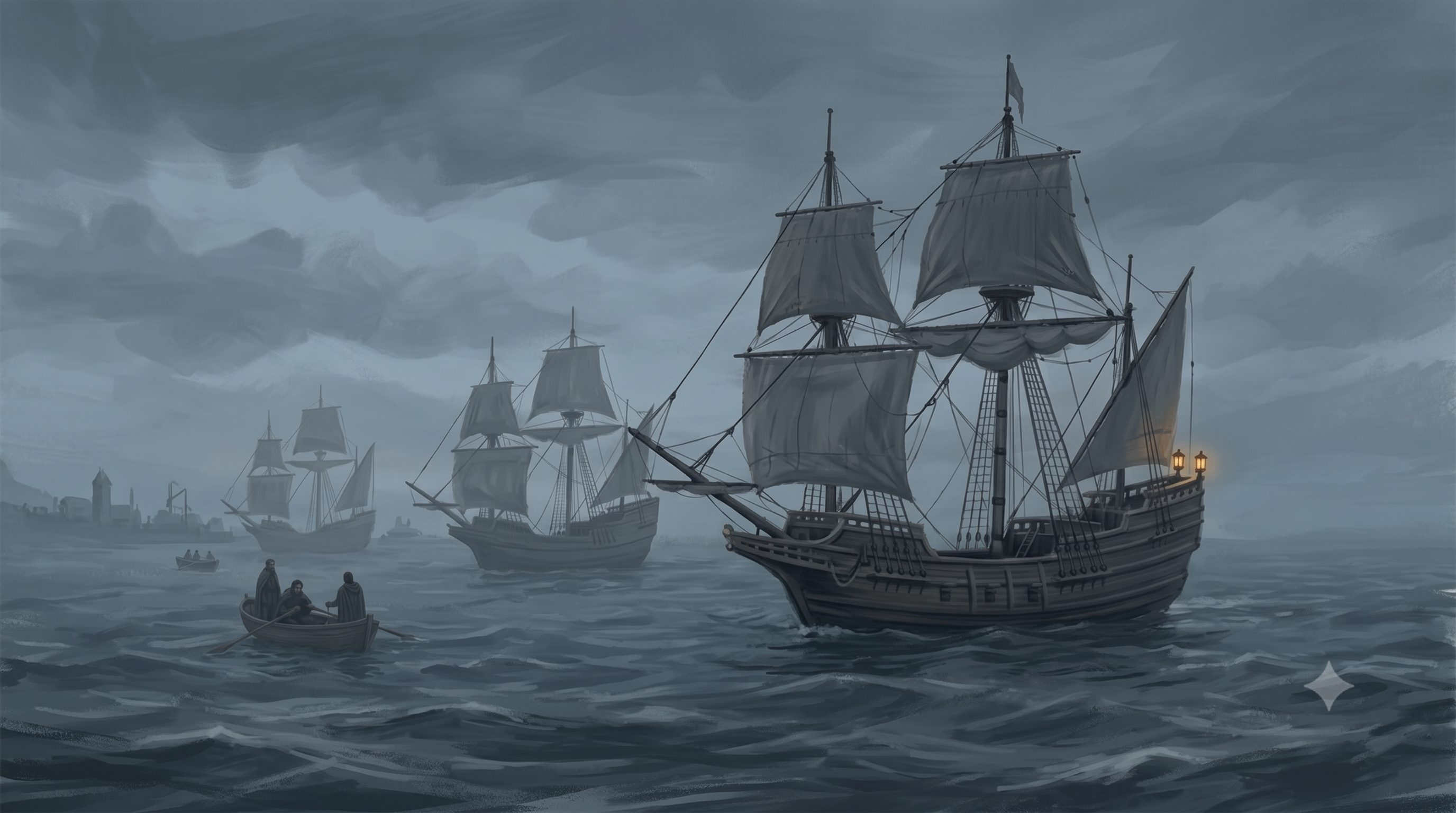
Full sail, calmer water — a very different rigging setup than a storm demands
The rigging in this calmer scene is set completely differently than it would be in a storm. In good weather, a crew set full sail to catch every bit of available wind. As weather worsened, sailors had to reef — physically tying up part of a sail to reduce how much wind it caught — or swap to smaller, heavier storm sails built specifically to survive high wind without tearing or overpowering the rigging holding them.
More sail isn't always better — sometimes the safest choice is deliberately using less power than the ship is capable of catching. Where else does holding back power on purpose actually make something safer or more effective?
Could you correctly judge, in the middle of changing weather, exactly how much sail was too much?
One Innovation, Four Trades Scrambling to Keep Up
Rigging innovation never happened alone — every improvement dragged three other trades along with it. Adding a third mast and more sail area meant the mast itself had to be taller and stronger, which meant shipwrights and mastmakers needed better timber and joinery. A taller, more heavily loaded mast needed more standing rigging holding it up, which meant ropemakers needed to scale up entire ropewalks to produce longer, thicker cable in larger quantities. More sail area meant sailmakers needed tougher canvas and stronger stitching to survive the added strain, or the new rigging would simply tear the sail apart. No single trade could improve in isolation — a better mast was useless without better rope, and better rope was useless without a sail strong enough to be worth raising in the first place.
One improvement in a system created new problems in three completely different trades, each of which then had to solve their own piece before the original improvement actually worked. Have you ever fixed one part of a problem only to discover it broke something else that now also needed fixing?
Could you manage a project where improving your own piece of it meant three other people, in three other trades, all had to improve their piece too, on your timeline?
What Replaced Hemp and Tar
Tarred hemp rope stayed the standard for centuries after this scene, right up until synthetic materials changed rigging again in the 20th century. Modern sailing rigs use fibers like Kevlar and Dyneema — materials many times stronger than steel by weight, that don't rot, and barely stretch under load — along with solid carbon-fiber rod rigging on the fastest racing yachts, and hydraulic or electric winches doing work that once took several grown men hauling by hand.
The basic problem — controlling a sail's shape against enormous force — never changed. Only the materials and the effort required to solve it did. What's a problem you can think of that's stayed exactly the same for centuries, even as the tools for solving it kept changing?
If you were handed a modern racing sailboat's rigging with no instructions, do you think your instincts from watching this scene would help you at all, or would it be an entirely different skill?
Rigging in Port
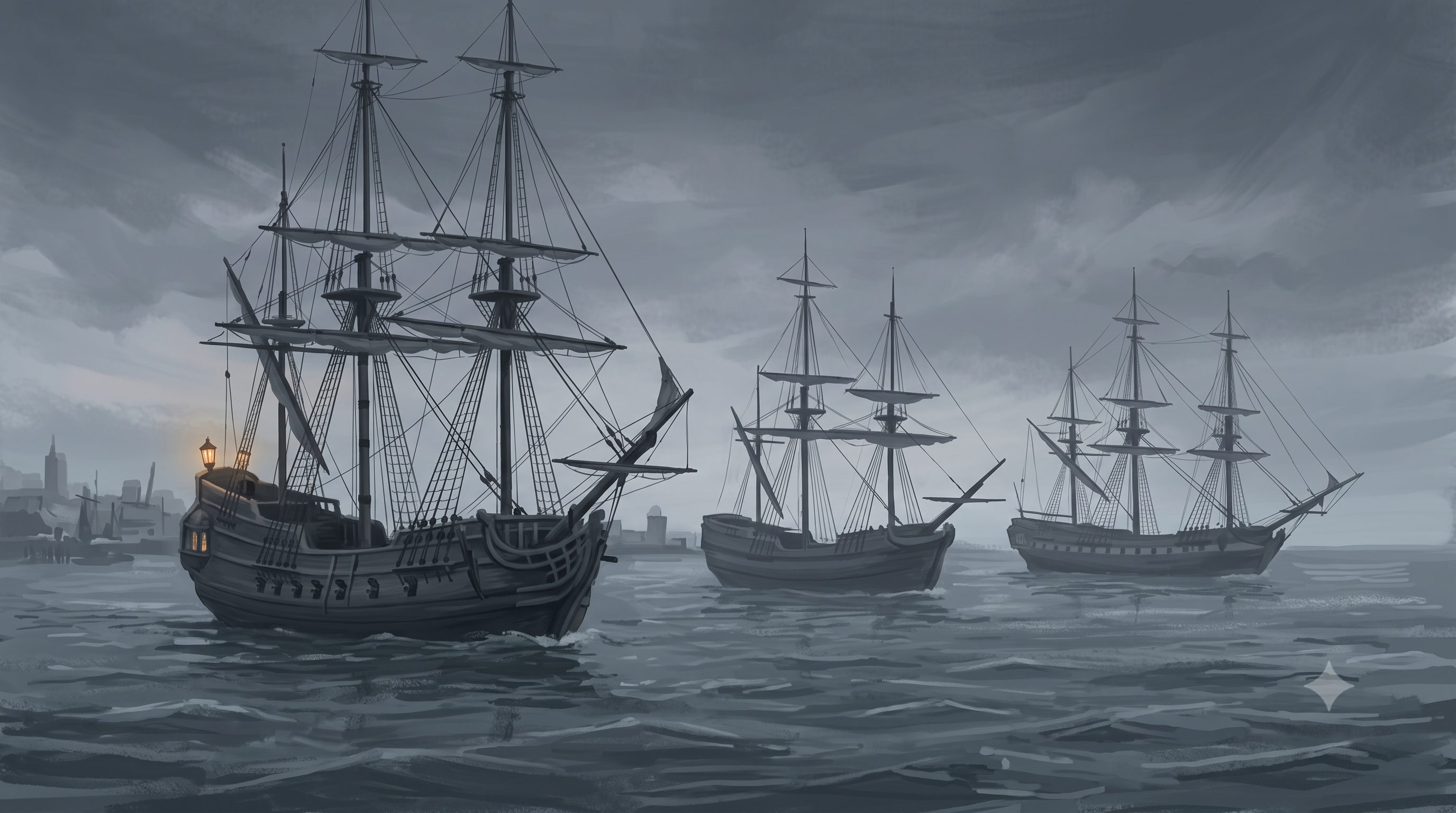
Ships at anchor, sails furled along the yards rather than set
Rigging's job didn't stop the moment a ship reached port. Every sail visible here has been furled — gathered up and bound against its yard rather than left hanging loose — because a sail left unsecured in harbor would flog itself apart in the wind or take on damaging weather for no reason, with nothing to show for it. Furling and unfurling sail was itself a rigging task, done by hand, every single time a ship arrived or prepared to leave.
Rigging kept working even after the sails came down. Dedicated dock cranes were limited and not always available, so crews frequently used the ship's own rigging as the tool for loading and unloading cargo — swinging a yard out over the dock and rigging a block-and-tackle system from it to hoist netted or slung cargo up out of the hold and back down to the pier. The same ropes, blocks, and mechanical-advantage tricks used to control a sail at sea were repurposed in port as an improvised crane.
The same rigging system did two completely different jobs depending on whether the ship was moving or standing still — propulsion at sea, a crane in port. What tools or systems do you use that quietly do a second job you don't usually think about?
Could you rig a safe, working hoist out of rope and pulleys alone, with no crane and no motor, to move something heavier than yourself?