❧
How You Actually Became a Captain
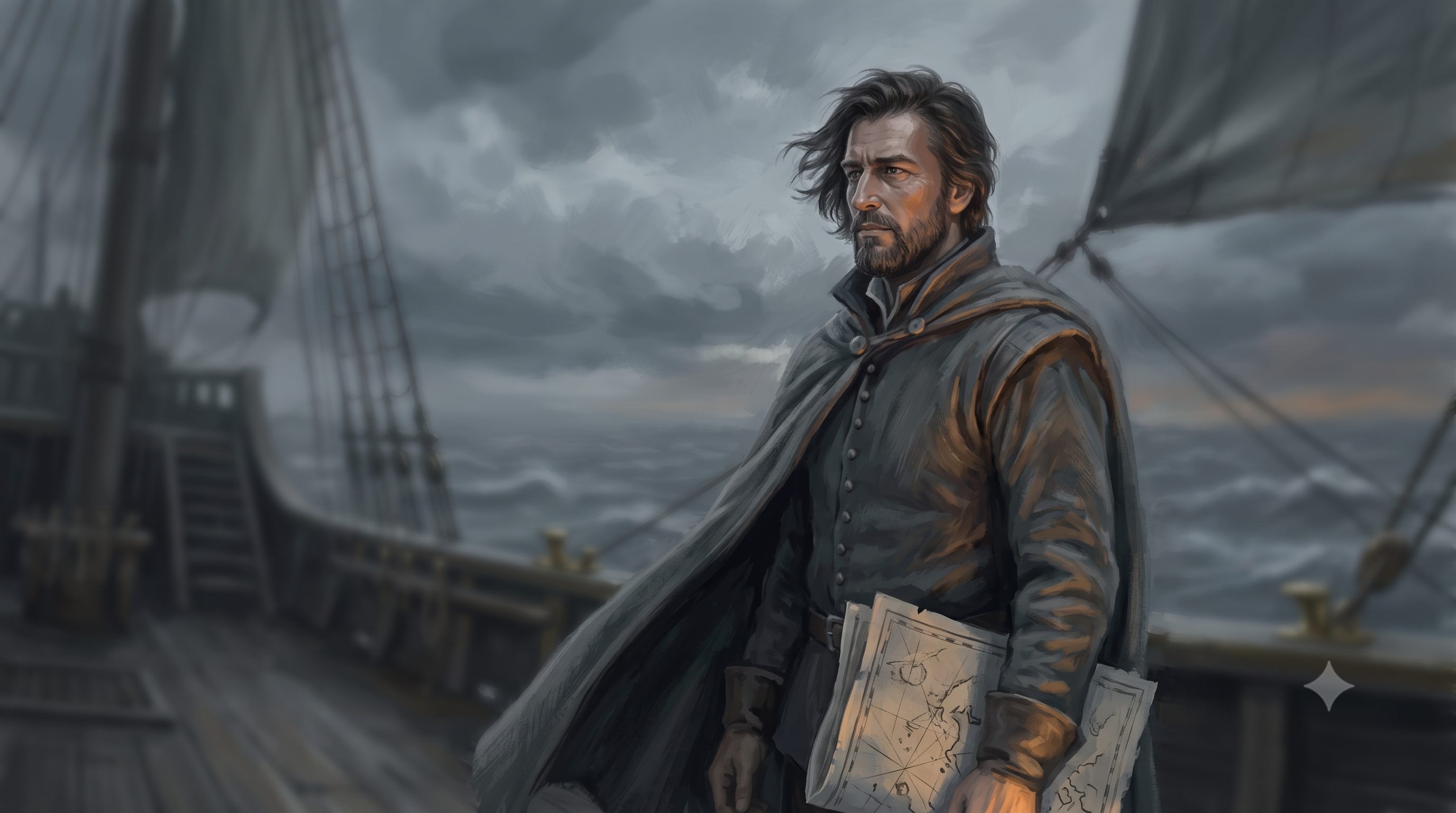
A captain trusted with the charts, the ship, and everyone aboard it
There was no naval academy, no formal license, no exam. A captain earned command the way this era earned most things: through reputation built over years, patronage from people with money at stake, and a track record that made investors willing to bet a ship and cargo on him personally. The word "captain" as a distinct rank — someone with overall command and legal authority, separate from the officer who actually handled navigation — had only fully taken hold in England in the 1580s, and was especially claimed first by privateers, men who'd already proven themselves capturing enemy ships under a government commission. Christopher Newport's path to commanding the Susan Constant fits that pattern exactly.
There was no formal test for the job — just accumulated trust from people who'd seen you perform under pressure before. What's a role today where the only real qualification is still "people who've worked with you vouch for you"?
Could you build the kind of reputation, over years, that would make someone trust you with their ship, their cargo, and their life savings all at once?
Captain and Master Were Two Different Jobs
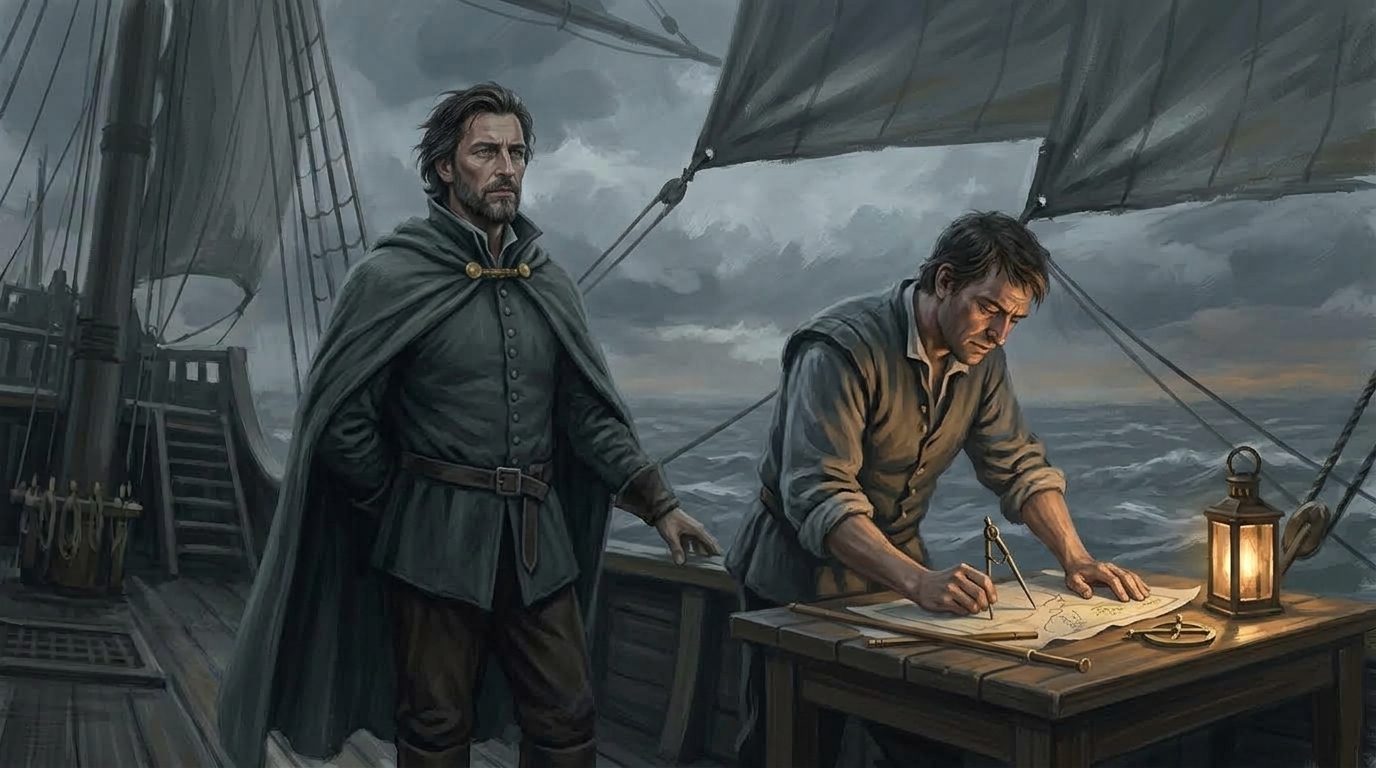
Two men, two jobs, the same deck
A captain wasn't necessarily the most skilled navigator on his own ship. That job usually belonged to the sailing master — a separate, highly trained specialist responsible for charting, log-keeping, and hands-on ship-handling. Traditionally, the master had controlled the ship entirely; the captain's role as overall commander, legal authority, and final decision-maker on top of the master grew alongside it. A good captain didn't need to out-navigate his master — he needed the judgment to know when to trust him, when to override him, and how to hold together everyone below them both.
Notice how differently the two men stand. The master is bent into his work, visibly absorbed. The captain stands upright, still, facing outward — the posture of command is also a kind of performance, held in place whether or not he feels as settled inside as he looks. That composure was part of the job too, and it rarely came free.
The person legally in charge wasn't necessarily the most technically skilled person on board. Where else do you see that same split — someone in command who isn't the most expert hands-on practitioner underneath them?
A captain's calm was often a performance held up for everyone else's sake, not necessarily what he actually felt. Have you ever had to hold a steady expression for other people's benefit while feeling something completely different underneath it?
Could you lead a team where someone under you knew more about the actual task than you did, without either resenting them or being intimidated by them?
The Final Authority
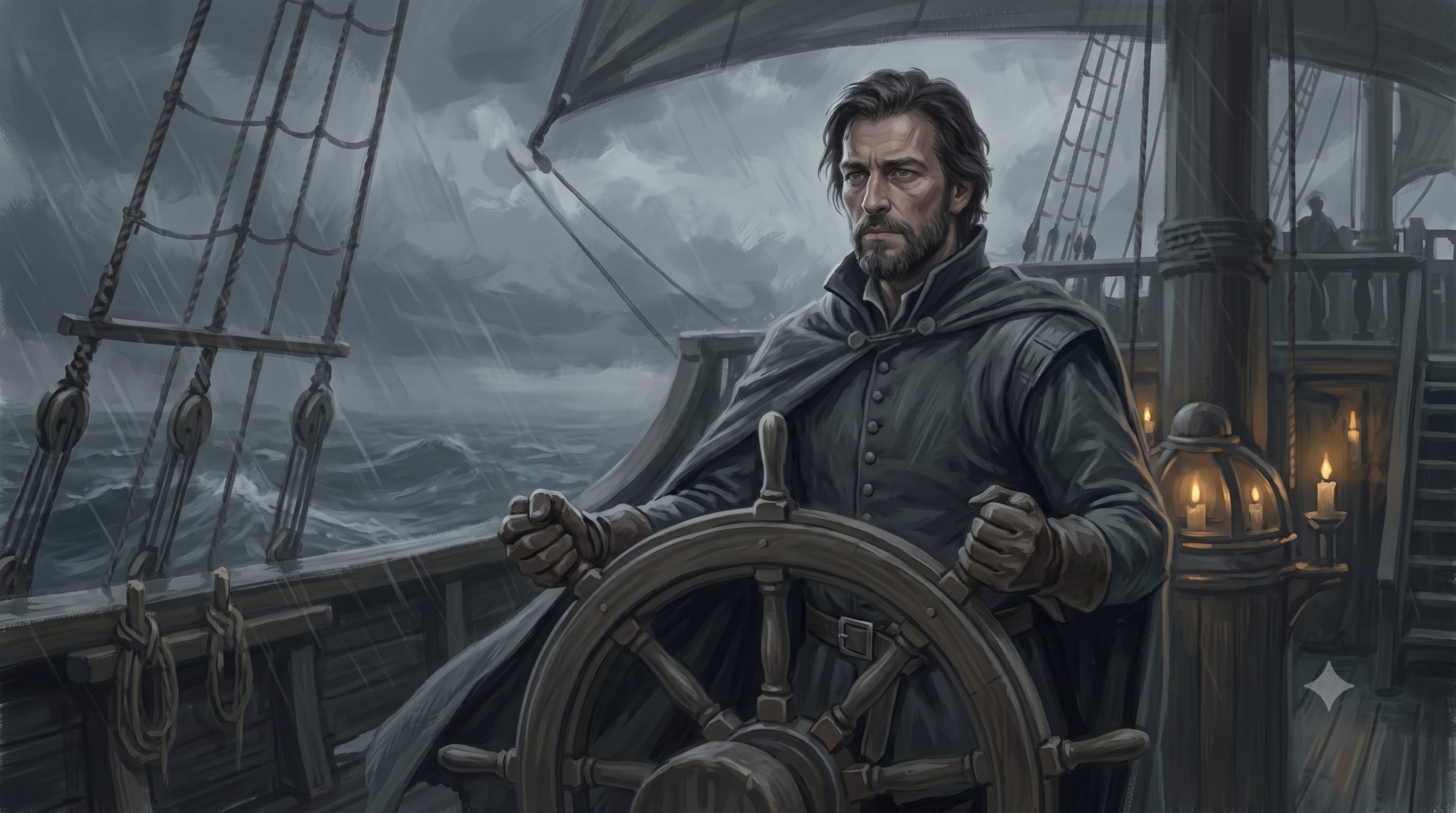
No one to consult, and no time to consult them anyway
English maritime discipline had real legal roots reaching back centuries — customary sea law recorded as early as the medieval "Black Book of the Admiralty," which spelled out actual punishments for actual crimes at sea (a convicted thief could be marked and set ashore; murder carried its own brutal, specific penalty). By this era, the English High Court of Admiralty existed on land to hear real disputes, including accusations of mutiny — a captain's authority wasn't simply his own unlimited whim. But none of that mattered mid-ocean in a storm. Out here, with weeks between him and any court, a captain's word was, in practice, the only law that existed in the moment it mattered.
Real legal limits existed on a captain's power — they just weren't reachable in the exact moments his power mattered most. Is a rule you can't actually enforce in the moment still a meaningful limit?
Could you make a life-or-death call, alone, with no one to check your judgment and weeks before anyone could review it?
Watched From Afar

Instructions and reports moved by letter — the only oversight distance allowed
A captain's total authority at sea didn't mean he answered to no one. Before he ever left port, he sailed under written instructions from the people who'd funded the voyage — investors, a company's directors, sometimes figures working quietly behind the scenes the way Bacon operated with the Virginia Company. Reports home, by letter, were how those backers judged whether their captain had done his job well. His command was absolute at sea and completely dependent on paper the moment he returned.
A captain answered to people who couldn't see anything he actually did until months after he'd already done it. What does that do to how carefully you'd choose your actions, knowing the full explanation would only come later?
Could you make dozens of consequential decisions, knowing the people judging your performance wouldn't hear about any of them until months afterward?
What He Owed His Crew
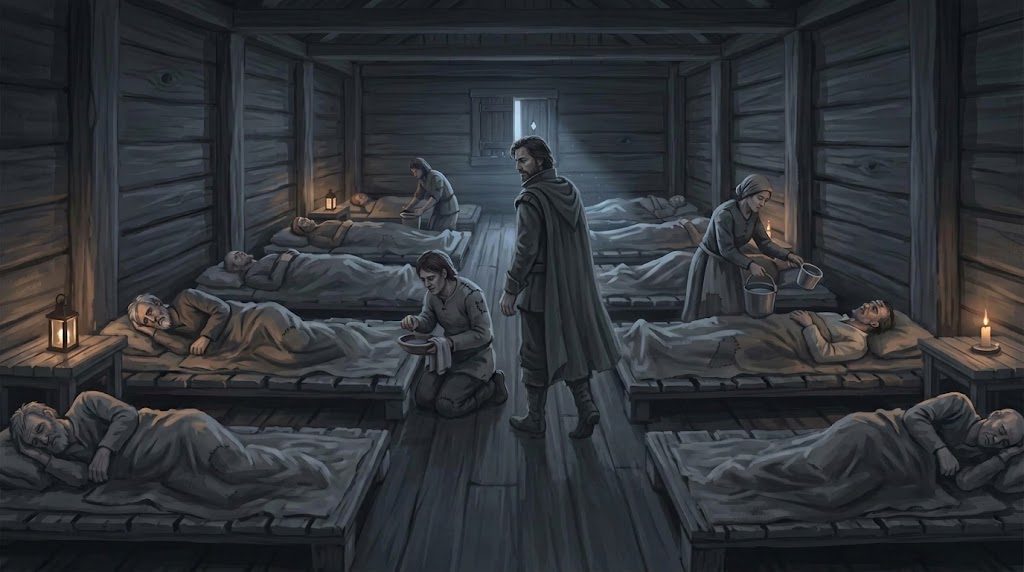
Command didn't stop at the sickroom door
Authority came with a real, legally recognized obligation attached: custom and law both expected a captain to look after his crew's basic welfare, not just command their labor. That's part of why mutiny was treated so seriously in maritime courts — it broke an understood two-way arrangement, not just a chain of command. Walking through a room like this himself, rather than sending someone else, was itself part of the job: a captain's visible presence during the worst stretches was one of the only tools he had to hold a frightened crew together.
A captain couldn't cure anyone in that room, and everyone knew it. What was he actually accomplishing by walking through it anyway?
Could you walk, calmly and visibly, into a room full of people you couldn't help, because your presence there mattered even without a cure?
Carrying the Weak Ashore
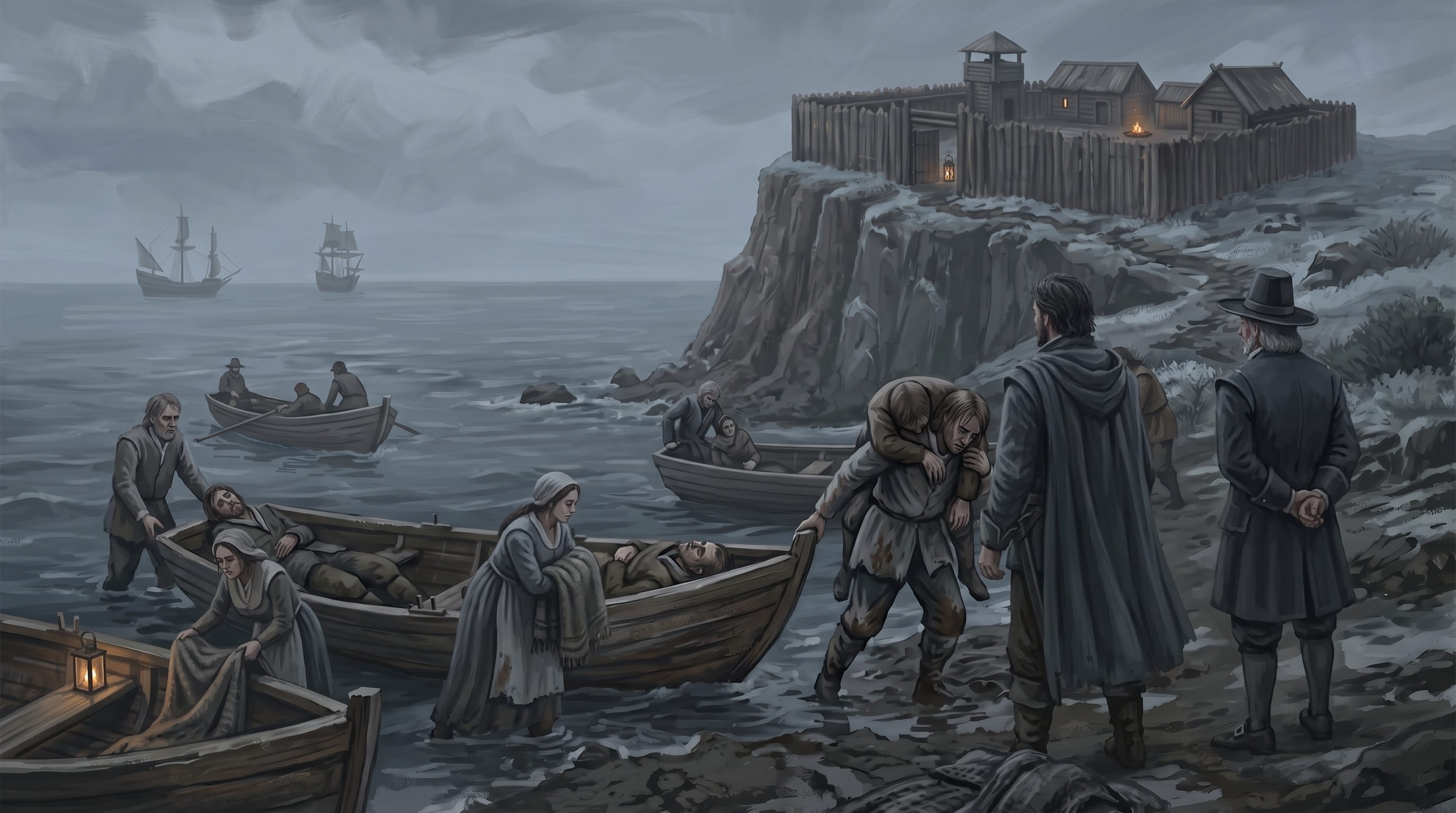
The men watching from shore carried responsibility for everyone in these boats
Leadership in this era wasn't only demonstrated at the helm — it showed in moments like this, where someone had to decide, in real time, who got carried first, who could still walk, and how a settlement with almost nothing was going to care for people who could no longer care for themselves. A captain or leader watching this unfold wasn't a passive observer; he was the person who'd ultimately answer for every one of these lives, on the voyage over and in the colony after.
There was no triage system, no trained medical staff, no protocol — just people making immediate judgment calls about who needed help most. How do you think someone learns to make those calls well, other than by being forced to make them?
Could you be the person others looked to for a decision in a moment exactly like this one, with no time to think it over?
Command Without Consultation
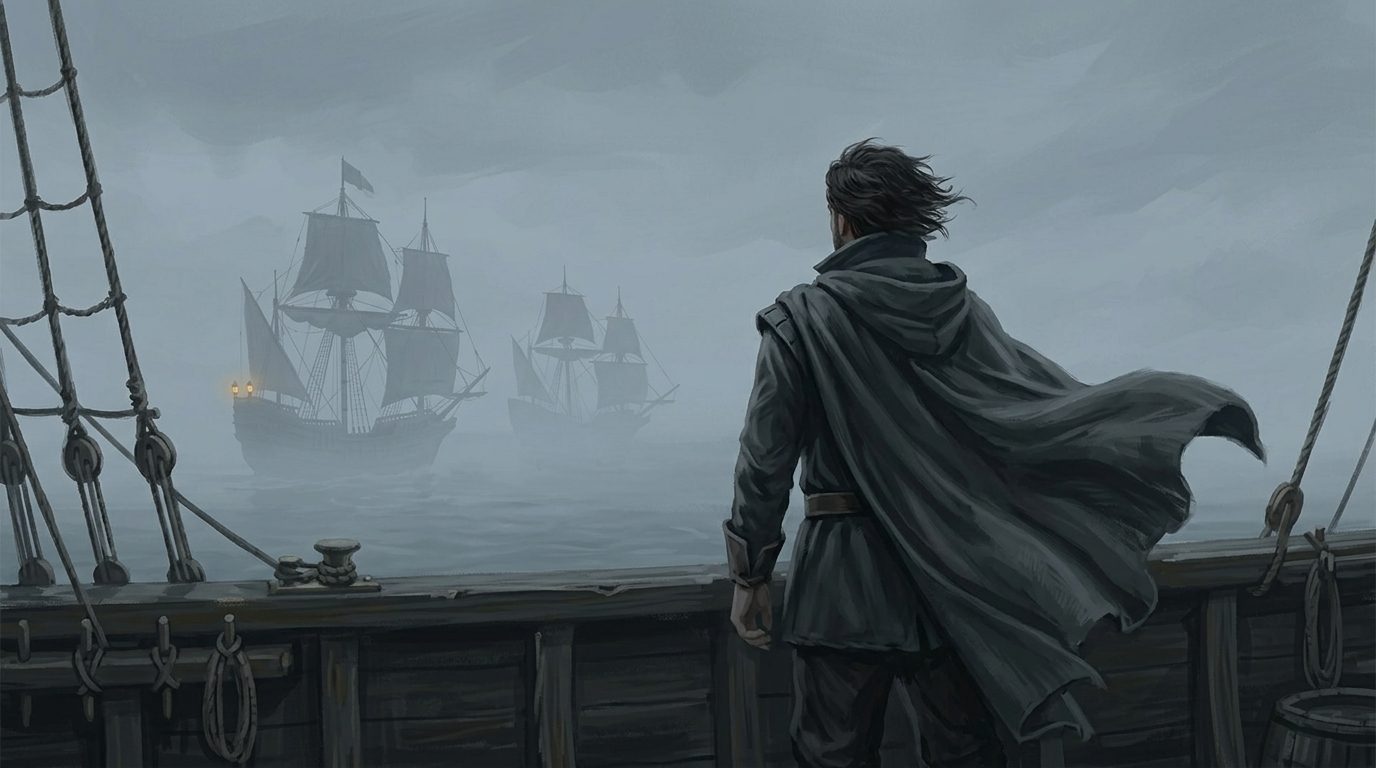
Watching over other ships too, with no way to signal them beyond sight and sound
On a multi-ship voyage like this one, a lead captain was also responsible for ships he couldn't even reach in the moment — no radio, no signal beyond flags, lanterns, and cannon fire, and none of those worked reliably in weather like this. Every other captain in the fleet was making his own independent decisions in real time, and the overall commander had to trust those judgment calls were sound, because there was no way to verify them from here.
Command over people you can't directly observe or correct in the moment requires a specific kind of trust. What does it take to genuinely delegate real authority to someone you can't check on?
Could you trust someone else's judgment completely, in a crisis, simply because you had no way to intervene even if you disagreed?
How Much to Tell the Crew
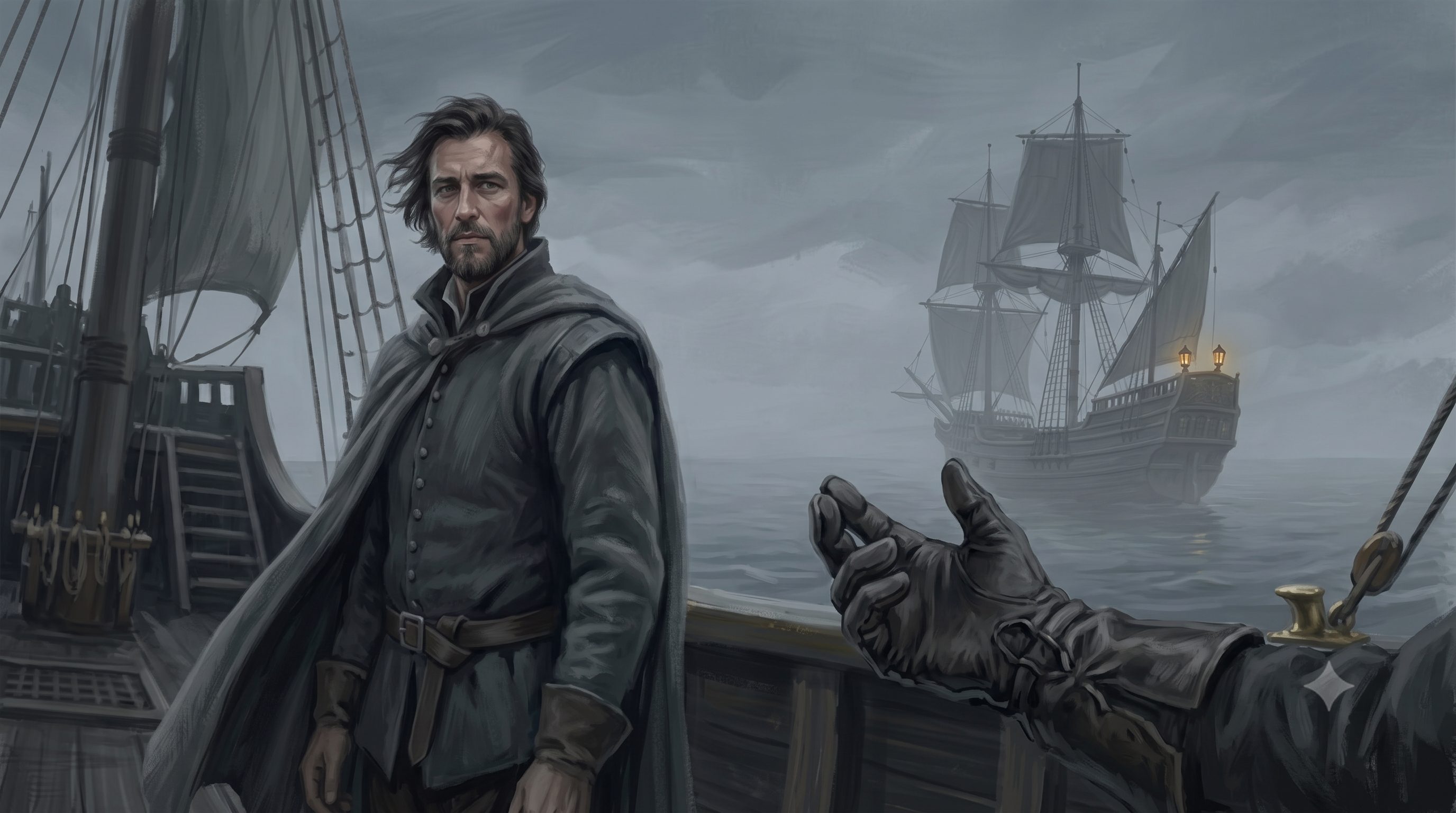
Partial trust, offered carefully — not the same as full disclosure
Command in this era regularly meant carrying knowledge the crew wasn't given — sealed instructions, the true financial stakes of the voyage, sometimes even the real destination, kept close by design the same way Bacon's own correspondence stayed deliberately private. A captain had to decide, constantly, exactly how much truth a frightened, exhausted crew actually needed in order to keep working, versus how much would only cause panic or mutiny if said aloud too soon.
Withholding information and lying aren't the same thing, but the line between them isn't always obvious in the moment. Where do you draw that line yourself?
Could you carry information you knew would frighten people, and decide, correctly, when — or whether — they actually needed to hear it?
Months or Years Away

A letter read more than once, a ship too far off to name
The 1606 voyage that founded Jamestown took roughly four months just to cross the Atlantic — the fleet left London on December 20 and didn't reach the Chesapeake until late April. Voyages to further destinations, like the East Indies, could keep a captain away for a year or more at a stretch. Many captains of this era genuinely were family men, with wives and children waiting at home for months or years between visits — real hardship for both sides, not a minor inconvenience.
This side of the story rarely made it into any log or letter home, because there was no reason for it to. A captain's private letters reported cargo, weather, and progress — not what it cost him to leave, and not what it cost the person left behind to keep waiting without knowing when a letter, or a ship, would actually arrive. Both of them carried something the other rarely got to see.
A captain might see his own children only a handful of times across their entire childhood. What do you think that did to those relationships — and to the choice to keep sailing anyway?
This waiting is just as much a part of this era's maritime story as anything that happened at sea, yet almost none of it survives in writing. What does it mean for something to be historically real but almost entirely undocumented?
Could you choose a career that meant being physically present for your own family only a few months out of every year or two?
The "Girl in Every Port" Question

A quiet tavern, long after the ships that once filled it have sailed on
The idea has a real historical seed: sailors really were gone for months or years at a time, and port towns really did develop their own economies built around returning sailors — taverns, boardinghouses, and informal relationships that were an open, well-documented part of maritime port culture for centuries. The 1972 hit song "Brandy (You're a Fine Girl)," by the band Looking Glass, captured exactly this trope: a barmaid in a busy port town who falls for a sailor who's honest that the sea, not her, is what he's actually married to.
But the popular image of every sailor — and especially every captain — keeping a woman waiting in every port is closer to folklore built from a real pattern than a documented universal fact. Career captains in particular had more riding on their reputation than an ordinary sailor did; that reputation was the entire basis of getting hired for the next voyage, and plenty of surviving personal letters and wills show captains genuinely devoted to families waiting at home. The truth sits between the romantic myth and a clean denial of it: real, long absences created a real culture around them, but it wasn't the universal behavior the legend suggests.
Notice what this scene doesn't show: no crowd, no celebration, just one woman alone at closing time with a small keepsake portrait on the wall. Whatever she actually felt about the man in that frame — and whatever he felt about her, weeks out at sea — neither version of that story was ever the one anyone wrote down.
A real pattern — long absence, port culture, taverns built around returning sailors — got exaggerated into a tidy legend about every sailor's behavior. What's another historical stereotype you can think of that probably started from something real and then got flattened into a myth?
Could you maintain a reputation for reliability and integrity across an entire career, knowing that reputation — and nothing else — was what got you your next job?