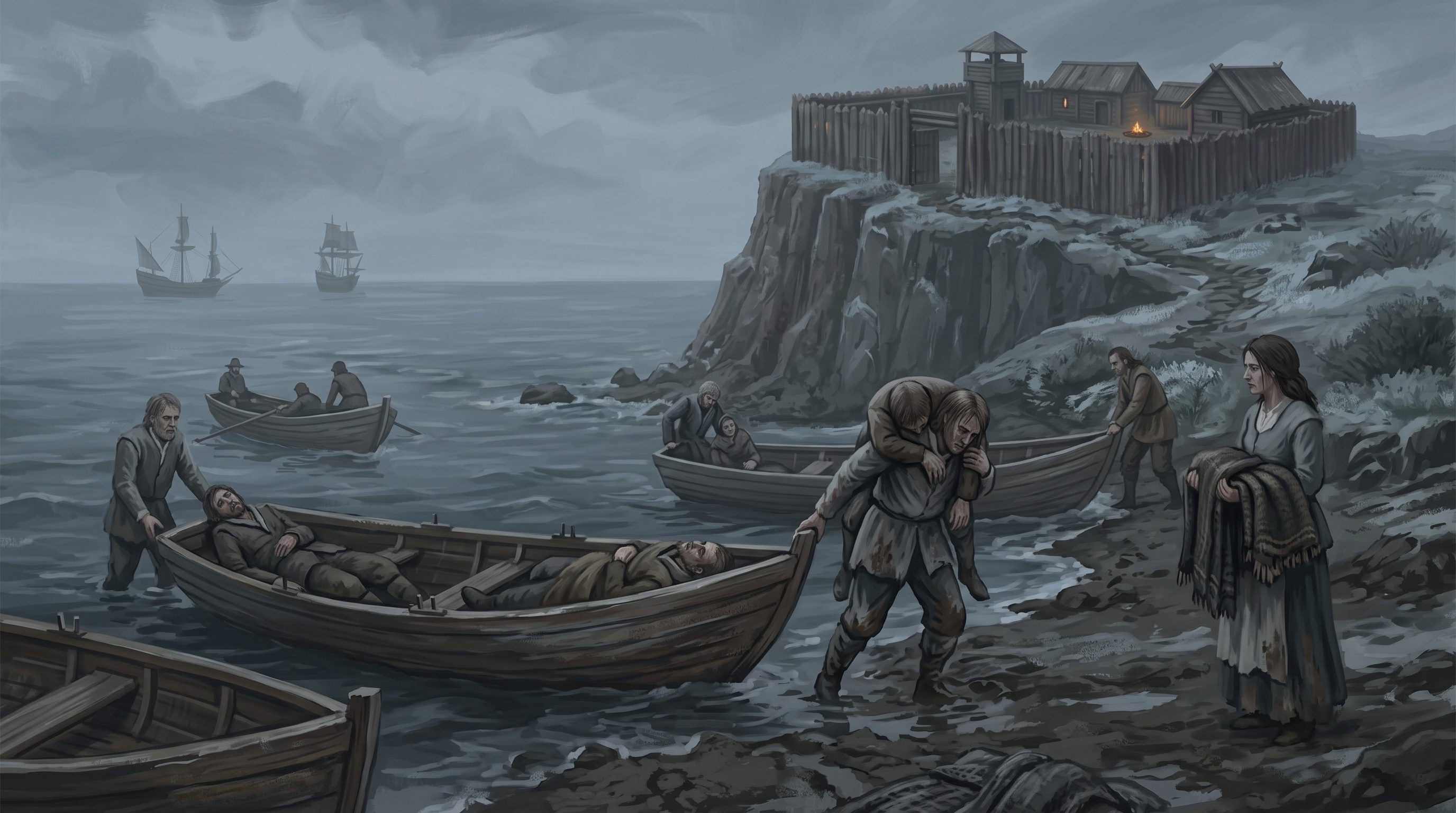
Plate 08 — bringing the sick and injured ashore near a cliffside fort
❧
No Escape at Sea
On land, getting sick means someone can go get help. In the middle of an ocean crossing, there was no help to get — the ship itself was the only hospital, the only pharmacy, and the only shelter that existed, whether it had what a sick person actually needed or not. If disease spread through a crowded, poorly ventilated ship, everyone aboard was already sealed in the same space as whoever was sick, with weeks left before land of any kind.
On land, "no help available" is rare and usually temporary. At sea in this era, it was the normal condition for the entire voyage. How do you think that changed the way people thought about their own health before they ever stepped aboard?
Could you stay calm getting sick on a ship, knowing the nearest real help was weeks away in any direction?
Did They Ever Divert?
Yes — when there was actually somewhere to divert to. The real 1606 Jamestown fleet didn't sail a straight line across the Atlantic; it deliberately took a longer southern route by way of the Canary Islands and the West Indies specifically to resupply food and water and let the sick recover before continuing north to Virginia. But that option only existed because land happened to be along the route. In the open mid-Atlantic, with no charted island for hundreds of miles, there was often genuinely nowhere to divert to, no matter how sick someone became.
A solution — diverting to land — existed, but only worked if land happened to be reachable. What's the difference between a real solution and a solution that only works under the right conditions?
Could you accept that the right decision — getting help — simply wasn't available to you, no matter how badly you needed it?
Turned Away at the Dock
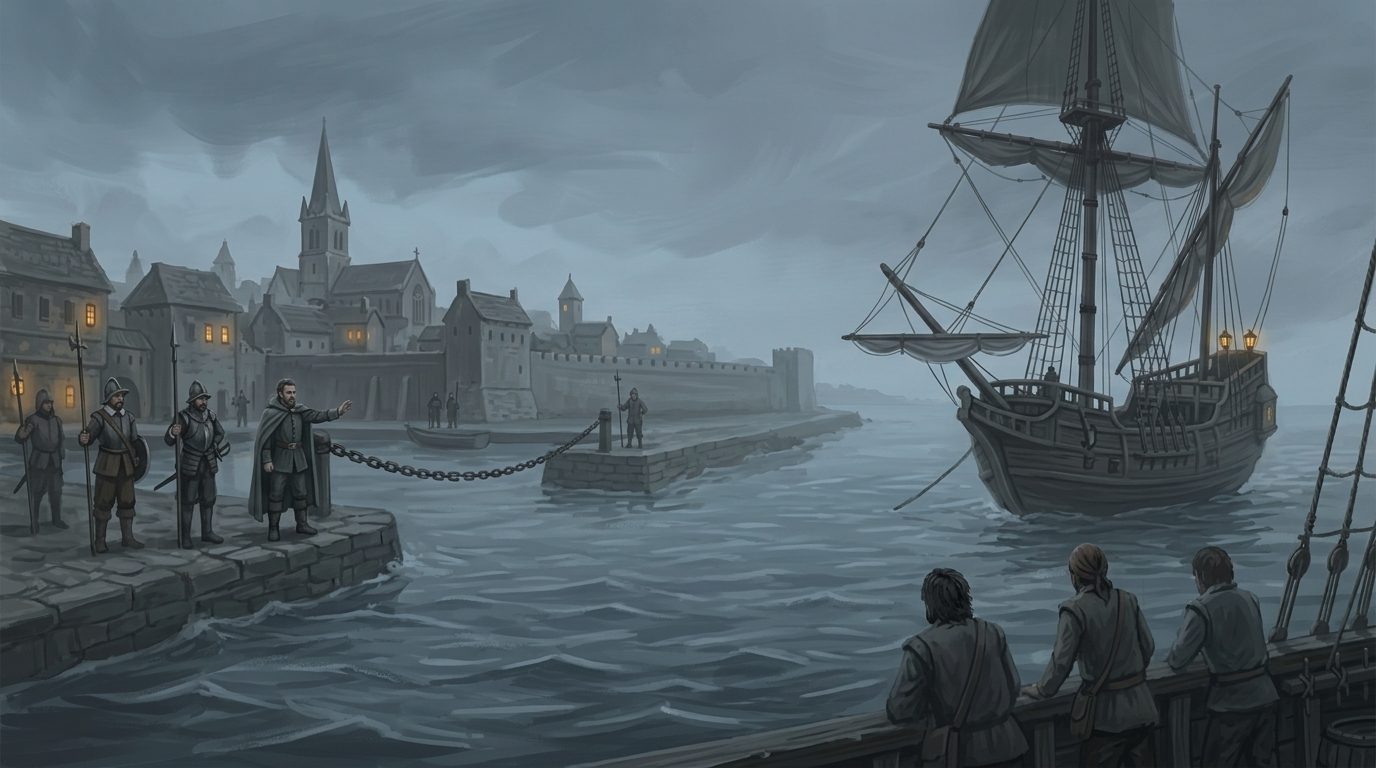
The harbor chained shut, the town close enough to see and no closer
Even reaching land didn't guarantee help — it could mean the opposite. By this era, European port cities already had a real, working concept of quarantine: Venice had required incoming ships to sit at anchor for forty days before landing since 1348, during the Black Death, and the practice had spread to other ports in the two and a half centuries since. A ship suspected of carrying sickness could be refused entry entirely, left waiting offshore with the very disease it was trying to escape.
Reaching land was supposed to mean safety, but a sick ship might be kept away from the one thing it needed most. Why would a port city choose to protect itself this way, even knowing it meant leaving sick people waiting?
This isn't just a similar idea today — it's the same institution, barely renamed. The CDC still operates 20 Port Health Stations at America's major points of entry, and until recently they were officially called "Quarantine Stations" — the exact word this scene is built around. CDC health officers there hold real legal authority to detain, isolate, or deny entry to anyone carrying a disease specified by Executive Order as quarantinable (currently including cholera, plague, smallpox, yellow fever, and any new flu strain capable of causing a pandemic). The chain across this harbor mouth has a direct modern descendant — it's just paperwork and a federal health officer now instead of guards and iron.
Could you accept being kept away from help you could see right in front of you, because letting you in risked everyone else?
What Medical Aid Actually Existed
Larger voyages sometimes carried a barber-surgeon — a single tradesman who cut hair, pulled teeth, set broken bones, and treated wounds, all as part of the same job. Smaller vessels often had no dedicated medical person at all. None of them understood what actually caused most diseases; germ theory was more than two centuries away. Real treatment mostly meant comfort, not cure: rest, whatever herbal remedies experience suggested, prayer, and the presence of other people, since there usually wasn't anything more medically effective available to try.
Most of what passed for medical care here was really just comfort care — treatment that couldn't cure anything but made the experience less frightening. Is comfort care actually worth less than a cure, or just worth something different?
Could you sit with someone who was seriously sick, offering only comfort, knowing there was genuinely nothing else you could do?
Burial at Sea, Burial on Land
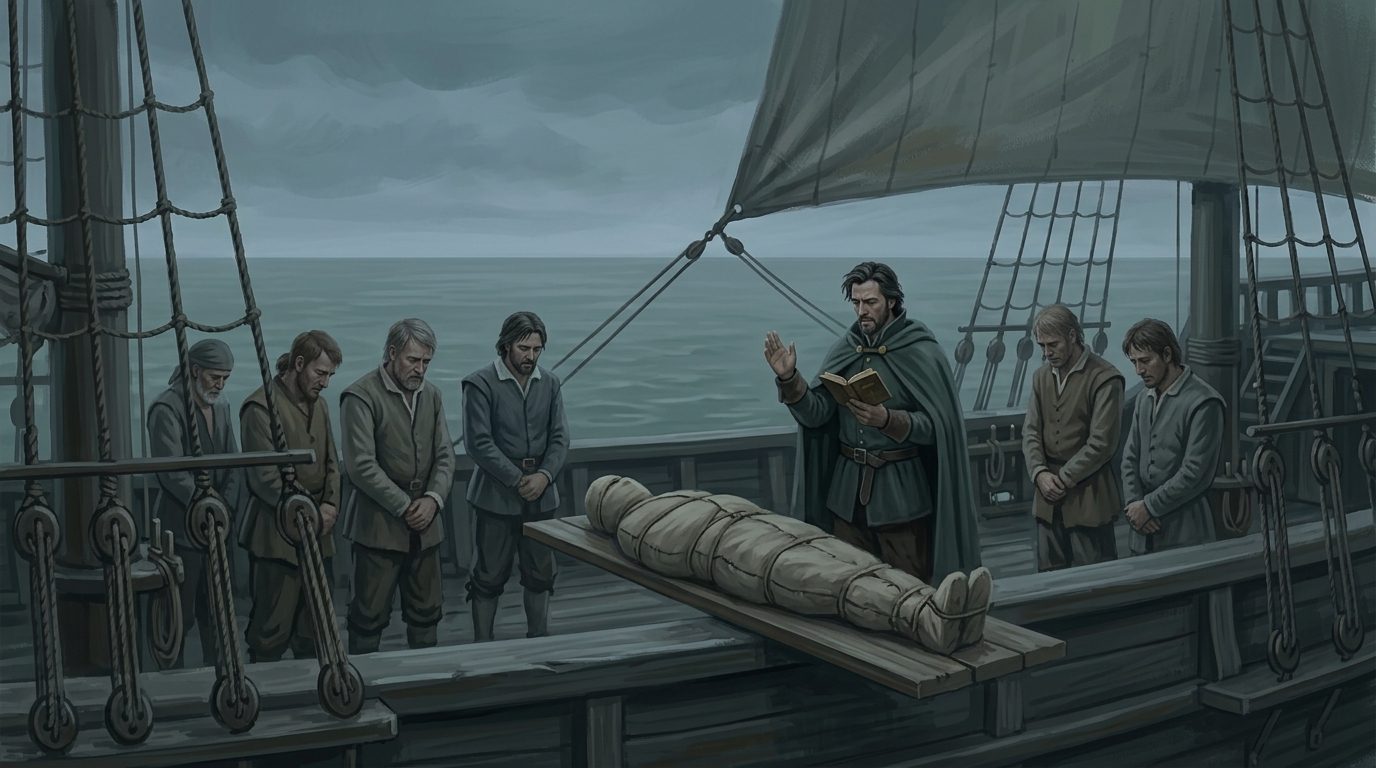
No land, no grave, just a shrouded body and a few words read aloud
When someone died mid-ocean, with no land anywhere near, the body was sewn into a weighted canvas shroud, a short prayer was read aloud — usually by the captain himself, since a ship rarely carried a dedicated chaplain — and the body was committed to the sea. There was no grave to visit afterward, no marker, nothing left behind at all except the memory of the crew who'd been there. Reaching land changed everything about how death was handled: Bartholomew Gosnold himself, dying after the ships had already reached Virginia, was buried on land inside the fort with real ceremony — cannon fired in volleys in his honor, his rank marked by a ceremonial staff placed on his coffin. The difference between those two burials was really just one thing: whether there happened to be solid ground underneath the mourners.
The exact same loss was handled completely differently depending on nothing more than geography — whether land was under the ship or not. What does that tell you about how much of "proper" ceremony actually depends on circumstances outside anyone's control?
This tradition never stopped — it's still an active program. The U.S. Navy's Burial at Sea Program is open, free of charge, to active-duty service members, honorably discharged veterans and retirees, and their eligible dependents. The Navy performed 806 burials at sea in 2023 alone, averaging roughly 1,500 cremated remains and about 15 full casketed remains a year. The ceremony still carries the same core shape seen in this scene — a service read aloud, remains committed to the water, no grave left behind — with a flag folded and a rifle volley added on top. Families can't attend in person; they receive only the ship's location afterward, the same absence of a fixed place to visit that this era's sailors would have recognized immediately.
Could you say a final goodbye to someone knowing there would be no grave, no marker, nothing left to visit afterward?
The Evidence Sits in This Very Story
The clearest historical evidence of how devastating sickness could be isn't a distant example — it's Bartholomew Gosnold himself, the captain this entire album is built around. He fell ill and died after a three-week illness on August 22, 1607, barely three months after landing. Roughly two-thirds of the colonists who'd survived the ocean crossing died that same first summer. A colonist named Edward Wingfield wrote afterward that Gosnold's life had carried "a great part of the good success and fortune" of the whole colony — meaning even the people who lived through it understood exactly how much they'd lost, and how little anyone could have done about it.
The man whose leadership this entire voyage depended on couldn't be saved by anything available at the time. What does it mean for a colony's fate to rest that heavily on one person's survival?
Could you keep leading, keep making decisions, in a place where roughly two out of every three people around you might not survive the year?
Look Again: The Fort on the Cliff
Easy to miss on a first look: the fort itself sits on an isolated cliff, reachable only by a narrow path, walled entirely in a wooden palisade with a watchtower and a lit beacon burning on the wall. That single detail says as much as anything in the foreground — even having reached land, this settlement was still cut off, still hard to reach, still a small defended point with no real backup nearby. Arriving on land didn't mean arriving somewhere safe; it meant arriving somewhere slightly less dangerous than the ocean.
The fort's isolation is easy to overlook because the sick and injured in the foreground pull your attention first. What else in a historical image do you think gets missed because something more dramatic is happening in front of it?
Could you feel safe arriving somewhere that was only slightly less dangerous than the place you'd just escaped?
Look Again: She Was Already Waiting
The woman standing on the shore is already holding folded blankets, ready before the first boat has even fully landed. That's not incidental — it means this wasn't the first time this exact scene had happened. Someone in this settlement had already learned, through repetition, to have warm cloth ready the moment boats carrying the sick and injured came into view. A single detail like that quietly reveals a routine, not a one-time emergency.
Being prepared before a crisis even fully arrives is its own kind of evidence — proof that something has happened before and is expected to happen again. What does her readiness tell you that the sick men being carried ashore don't?
Could you keep showing up prepared for the same hard task, over and over, without it hardening you or breaking you?
Look Again: More Than One Boat, More Than One Story
There isn't one boat here — there are several, each carrying a different situation at once: an elderly man rowing alone, a couple seated together, men clearly wounded rather than simply sick. This wasn't a single dramatic rescue; it was an ongoing, exhausting operation, moving people ashore one small boatload at a time because there was no faster way to do it. The ships anchored offshore in the distance couldn't simply pull up to a dock — everyone and everything had to cross that water the same slow way, trip after trip.
A crisis handled through many small, repeated trips looks very different from a crisis handled all at once. Which do you think is actually harder on the people doing the work?
Could you keep rowing back out for one more trip, knowing there were still more people waiting, after you were already exhausted?