One Candle, No Undo
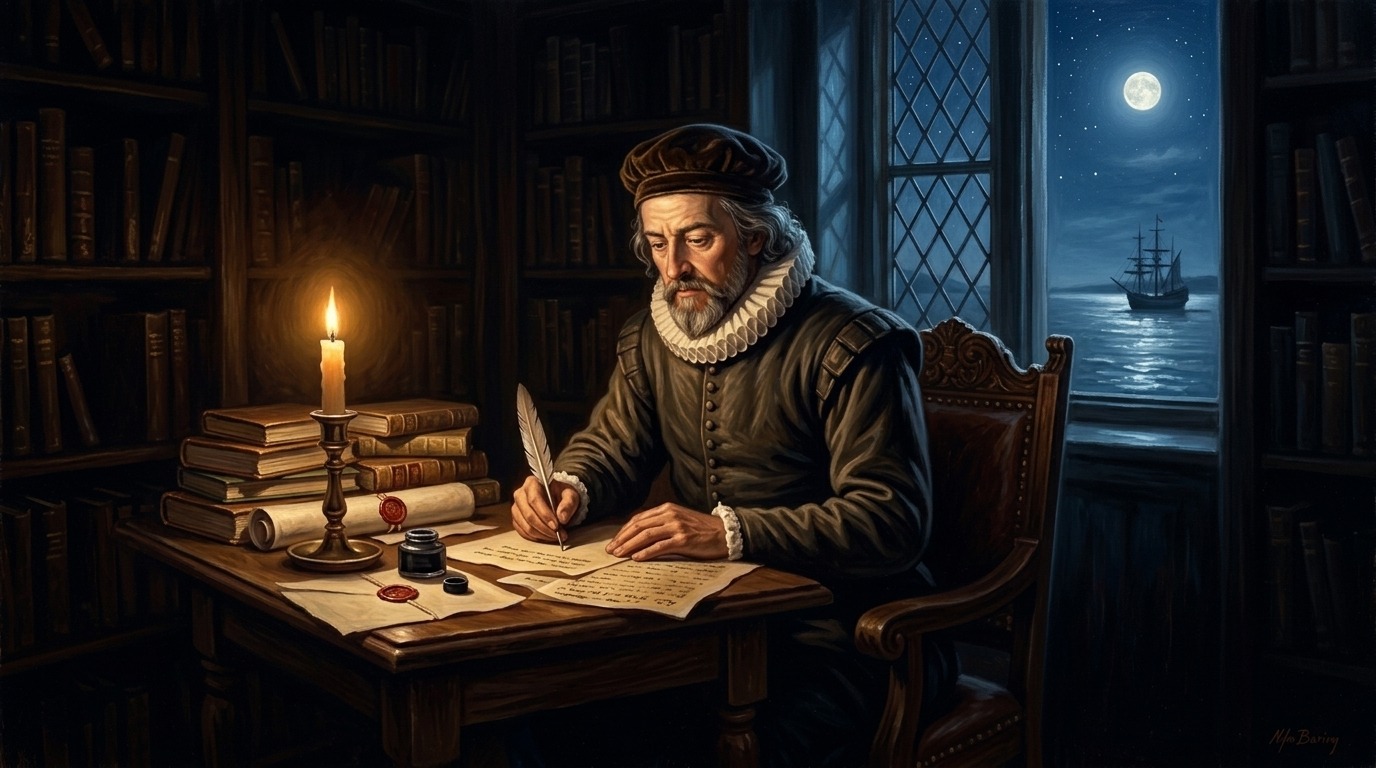
One man, one candle, one page — and a ship waiting in the dark outside the glass
This Lesson's Illustration Notebook: Plate 02 — Bacon at Candlelight ↗
Scene 1 — Nothing Else to Look At
Source: Illustration Notebook, Plate 02 — Bacon at Candlelight, Element 1
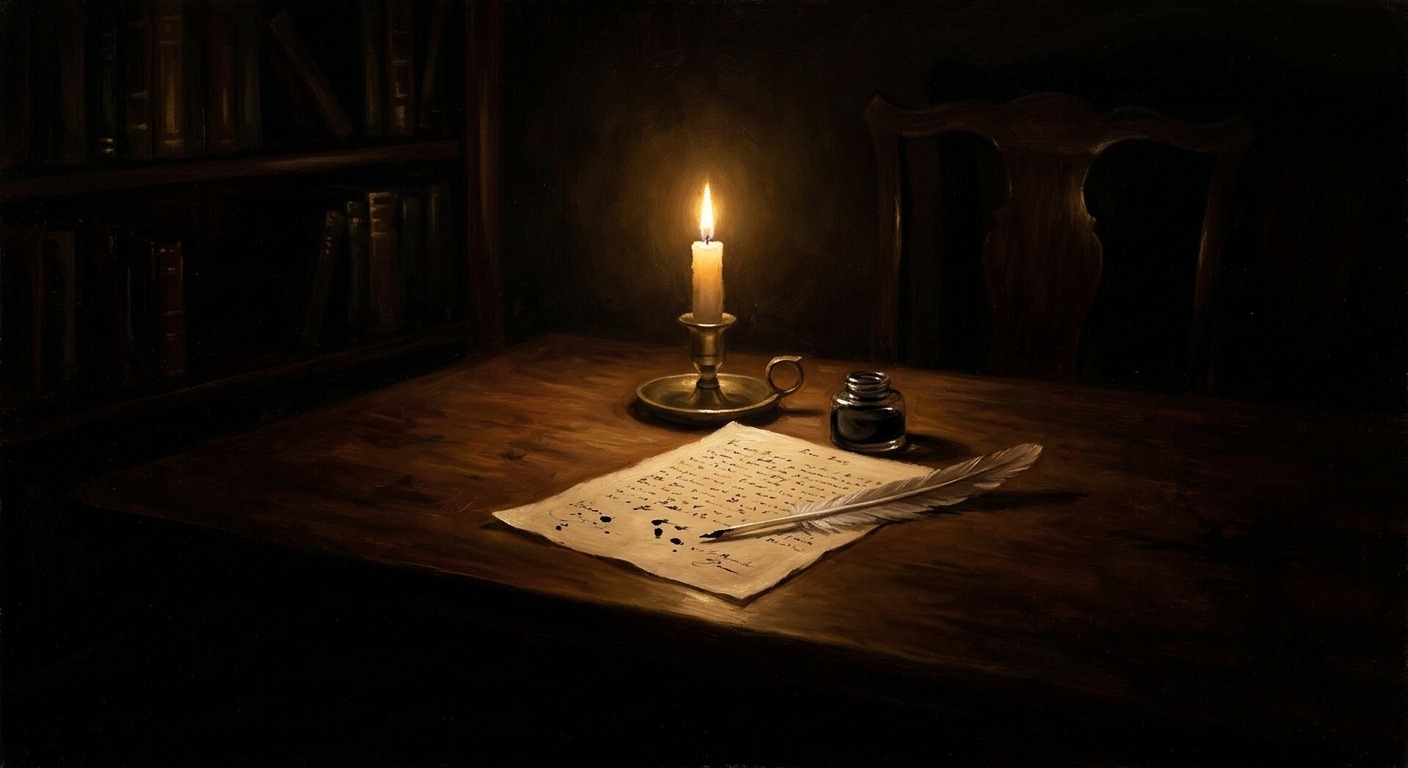
One candle lights this whole room. Everything past its small circle — the shelves, the corners, the door — just disappears. That wasn't a mood he chose. That's what night looked like before anyone had a switch to flip. But notice what it also meant: nothing in that dark room was competing for his attention. No second screen glowing on the desk beside the page. No notification pulling his eyes sideways. Just the one thing in front of him, because it was the only thing there was to look at.
Tonight, turn off every screen in the house for twenty minutes and sit with one task by the dimmest light you're allowed. Write down what your mind did in the first five minutes, and what it did by the twentieth.
Scene 2 — Writing With No Undo
Source: Illustration Notebook, Plate 02 — Bacon at Candlelight, Element 2
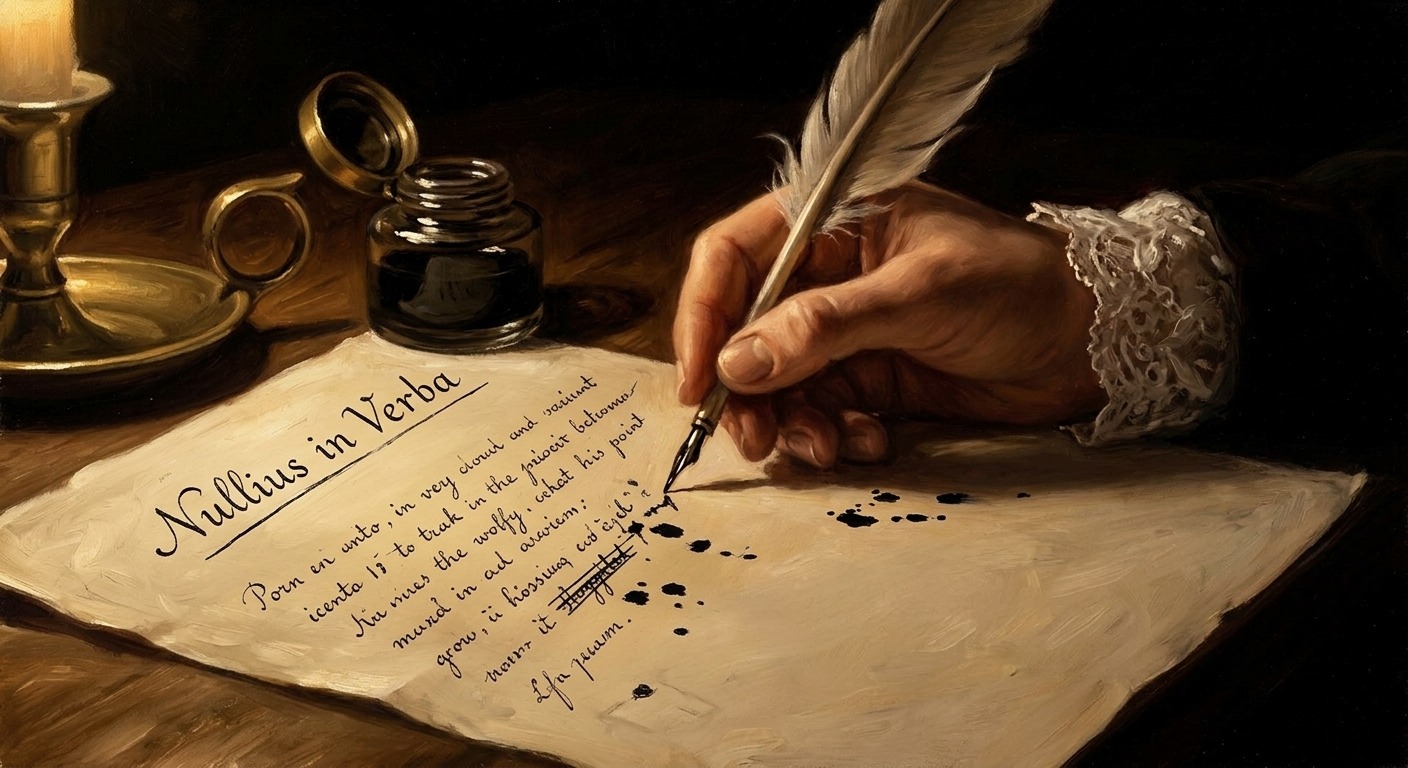
A quill had to be cut by hand, dipped every few words, and it left its mark the instant it touched the page — no backspace, no delete key, no quiet fix five minutes later. A sentence had to be mostly finished in his head before he ever let it reach the paper, because a mistake meant crossing it out in ink or starting the whole sheet over. Every word he kept, he'd already decided he could live with.
Write one full paragraph in your journal about anything at all — but you may not cross out, erase, or start over. Then write one sentence about how differently you chose your words once you couldn't take them back.
Scene 3 — The Ship in the Window
Source: Illustration Notebook, Plate 02 — Bacon at Candlelight, Element 3
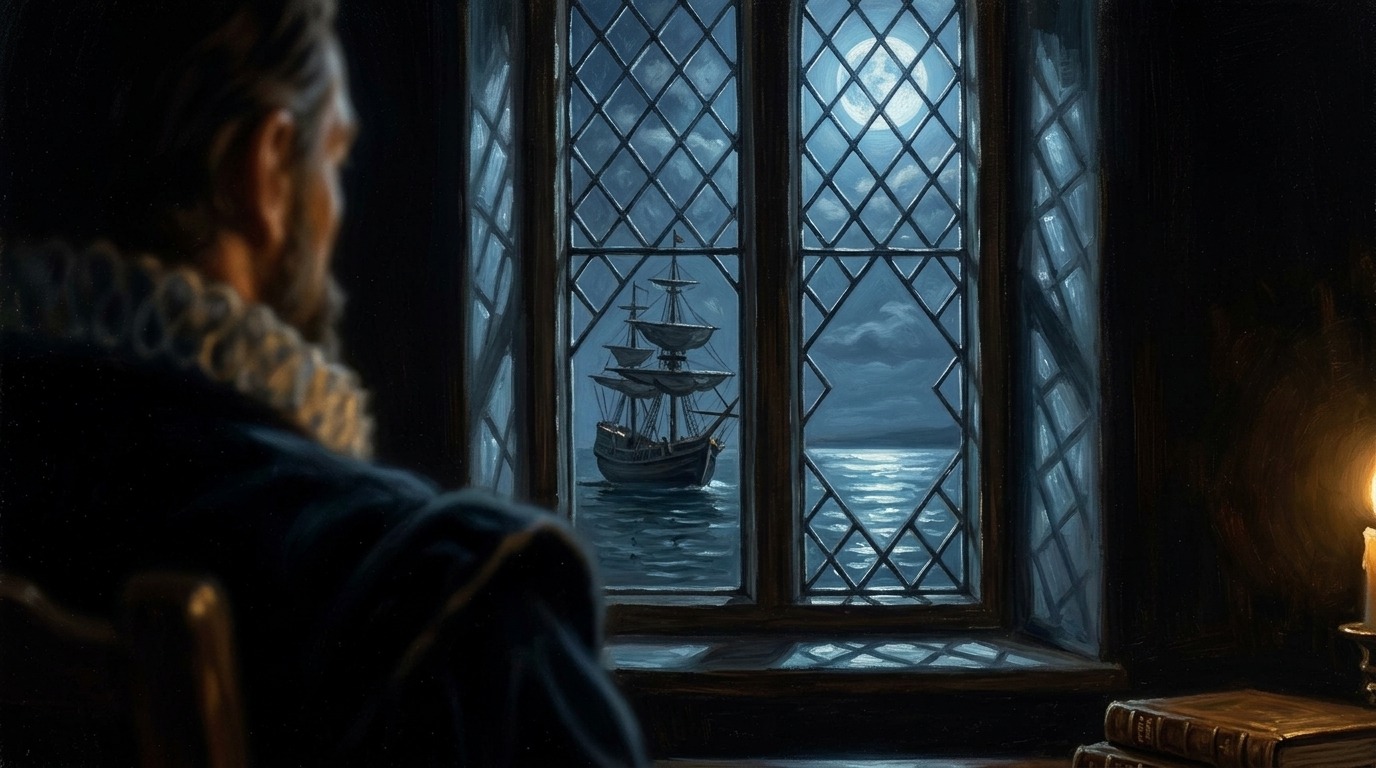
Behind him, framed in the window, a ship sits on open water under moonlight. That's the real distance his ideas had to travel — from a quiet room and a page of handwriting, across an actual ocean, into a chartered voyage carrying real people toward a real coastline. He wasn't only a man who wrote about how the world might be better. He was a working strategist behind the Virginia Company, turning private plans into ships that genuinely sailed.
Think of an idea you've had that never became anything real. Name the exact step that would have turned it into "a ship on the water" — and write down why that step never happened.
Scene 4 — The Library Wall
Source: Illustration Notebook, Plate 02 — Bacon at Candlelight, Element 4
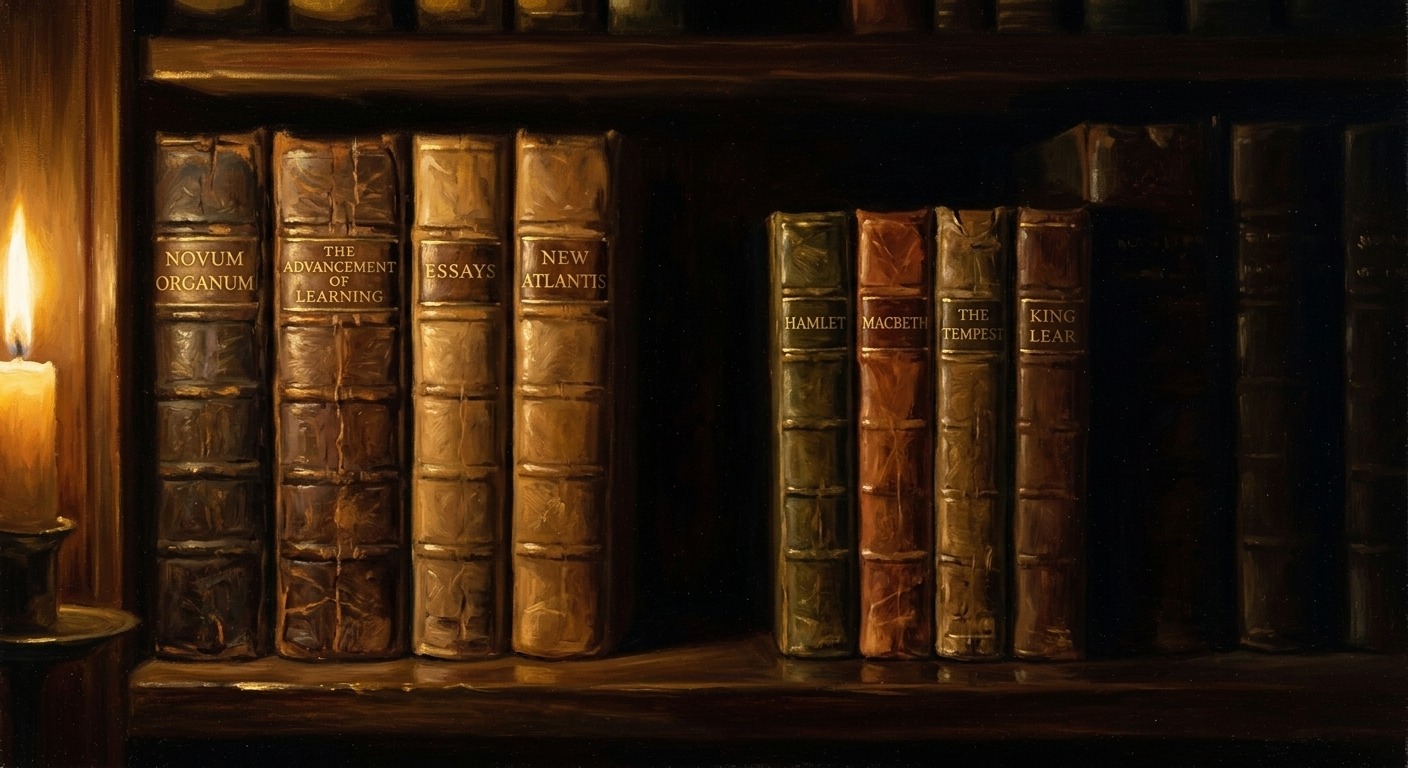
Shelves of hand-bound books line the wall behind him. In this era, a personal library at this scale was itself a form of wealth — most people in the 1600s owned no books at all, since every single one was made by hand and priced accordingly. For a mind like his, those shelves weren't decoration. They were raw material. His entire project of organizing and advancing human knowledge depended on having exactly that kind of accumulated, hard-won material within arm's reach.
Today, almost any book ever written is a few taps away, free or nearly free. Argue in writing: does having instant access to more information than Bacon's entire library actually make people better thinkers than he was? Take a side and defend it.
Scene 5 — The Rolled Letter on the Table
Source: Illustration Notebook, Plate 02 — Bacon at Candlelight, Element 5
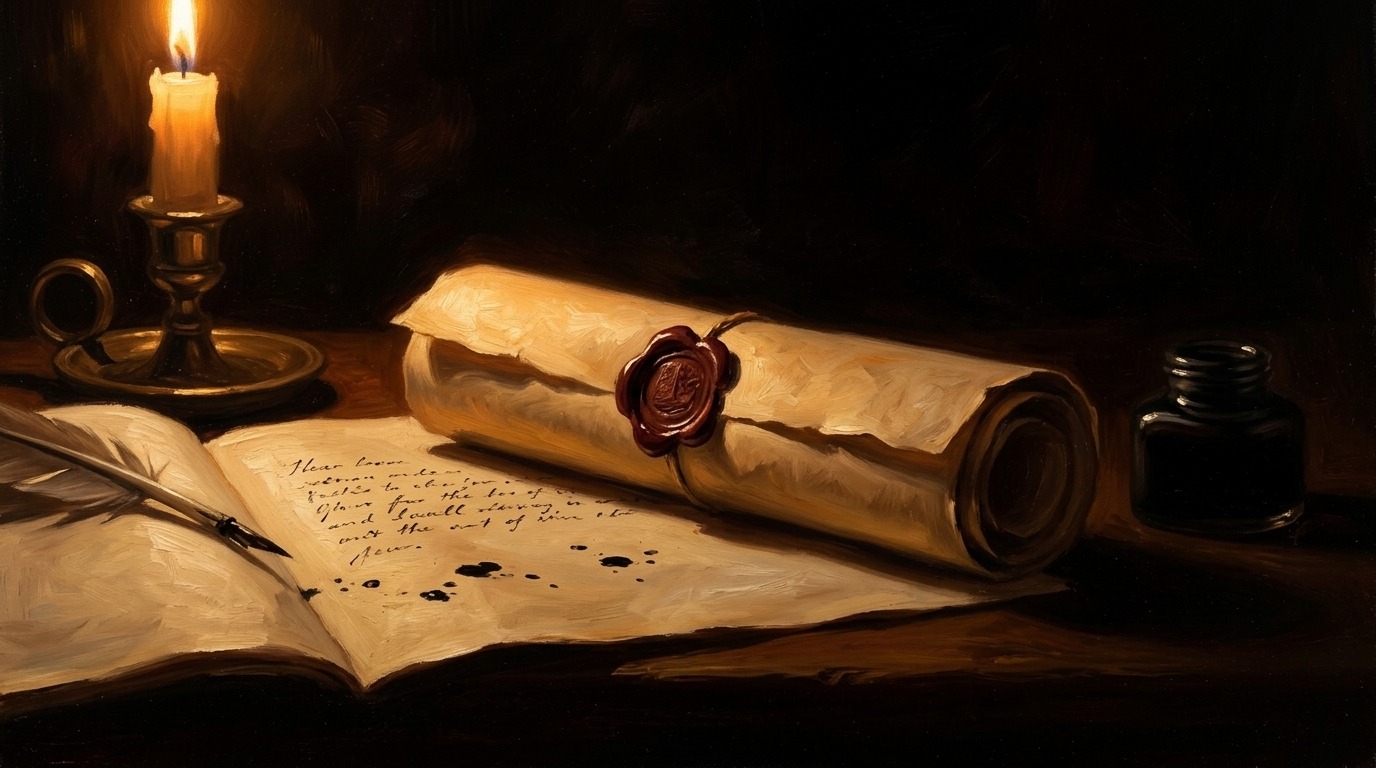
Beside his current page sits a rolled document — almost certainly a letter, since that was how ideas, instructions, and influence actually moved across distance in his era. A great deal of his real-world influence traveled this way: not through the books he published for the public, but through private letters to patrons, colleagues, and Virginia Company shareholders that never became public at all.
Some of the most important decisions in history were made through letters no one but the sender and receiver ever read. Write about a private conversation or message you've had that quietly changed something real — one nobody else ever saw.
Scene 6 — Dressed for No One
Source: Illustration Notebook, Plate 02 — Bacon at Candlelight, Element 6
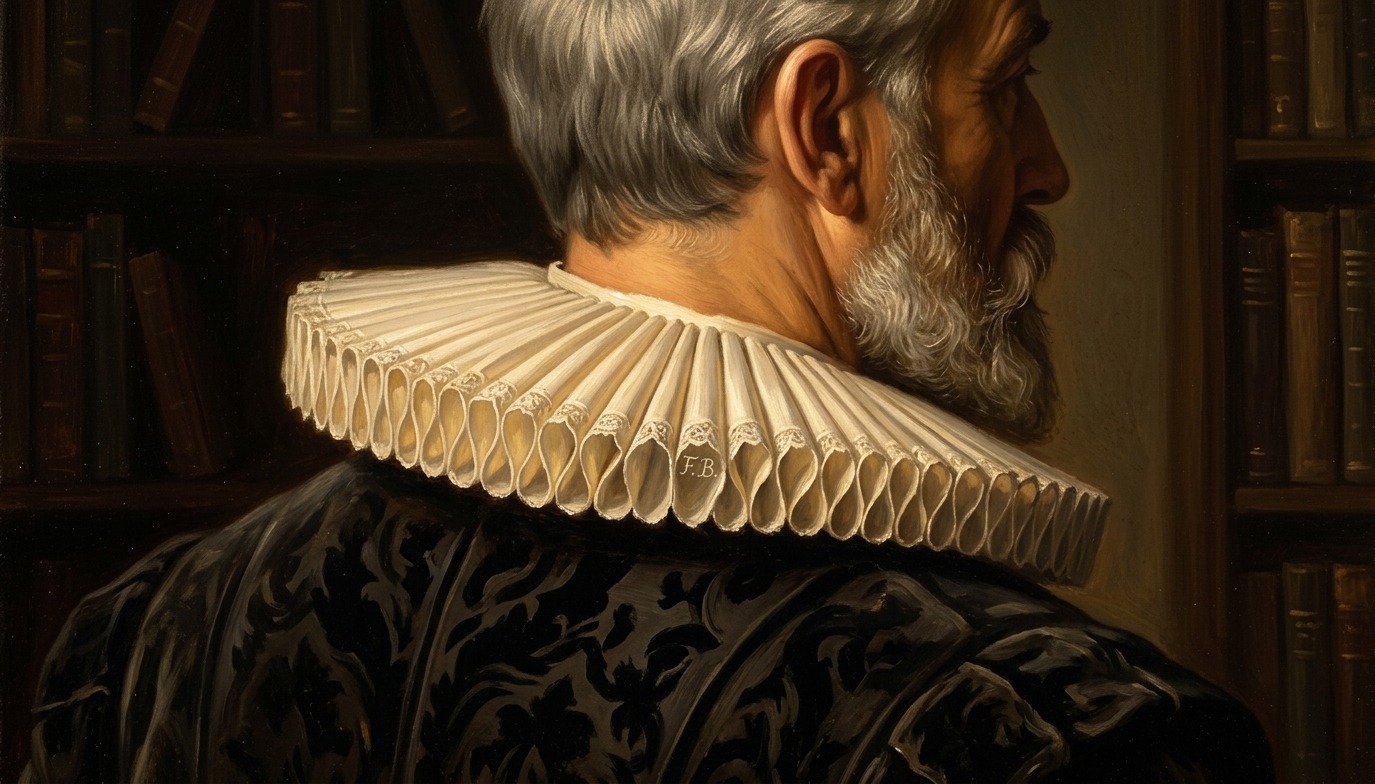
The stiff, pleated white collar he's wearing — a ruff — wasn't a fashion choice so much as a maintenance commitment. It had to be starched and pleated fresh, often by a dedicated laundress, and wearing one signaled that the household behind you could afford to keep it looking right. He is completely alone in this room, at night, with no one to see him. And he is still dressed exactly as what he was: a man of rank, keeping the standard even when the standard had no audience.
Name one standard you keep even when nobody would ever know if you dropped it. Then write about whether you actually keep it every time, or only when it's convenient.
Why This Lesson Matters
Look back at what actually happened in this room. Nobody watched him choose one candle over a brighter lamp he couldn't have owned anyway. Nobody watched him get a sentence right before committing it to ink. Nobody read the private letters that moved his real influence across an ocean. Nobody was there to notice whether his collar was starched. Every single thing in this Lesson happened with no audience at all — and every single thing in this Lesson is also, directly, what let something enormous happen in public: a colony, a body of law, a body of writing that's still read four centuries later.
That's the same hedge from Lesson 1, wearing a different disguise. The public thing — the ship, the charter, the finished essay — is never actually the impressive part. The impressive part is the unwatched hour before it: the discipline nobody applauds because nobody's in the room to see it.
This is worth taking seriously for one blunt reason: almost every hour of your life is unwatched. Nobody grades how you spend a Tuesday night alone. Nobody's checking whether you actually read the chapter or just skimmed it. Nobody audits whether you kept your word to yourself when it would have been easy not to. The people who end up doing something real are, without exception, the ones who treated those unwatched hours as if they mattered — because they were quietly betting that what happens when no one's checking is exactly what determines what you're capable of when everyone finally is.
Keep this one next to the hedge from Lesson 1. You're about to meet a man who sealed a promise with wax and his own signet, and a crew who trusted knots they'd tied themselves in the dark, in a storm, with no one checking their work either.
Challenge Experience
To be written once all ten Lessons are drafted — held back so it can be built with the whole arc in view rather than one Lesson at a time.
Go Deeper
Matching the pattern used in Lesson 1 — real targets pending for the Bacon Cabinet and Substack links.
The Vanguard — song page, lyrics & liner notes
Read Episode III on Substack — "Gosnold and the Vanguard"
The Forgotten Father of America — Bacon Research Center, Finding No. 001
Placeholder — Read the full Episode 3 argument on the Bacon Cabinet