The Signet and the Charter

One ring, pressed into wax — and in its day, the entire proof that a promise was real
This Lesson's Illustration Notebook: Plate 03 — The Signet and the Charter ↗
Scene 1 — The Ring That Was the Whole System
Source: Illustration Notebook, Plate 03 — The Signet and the Charter, Element 1
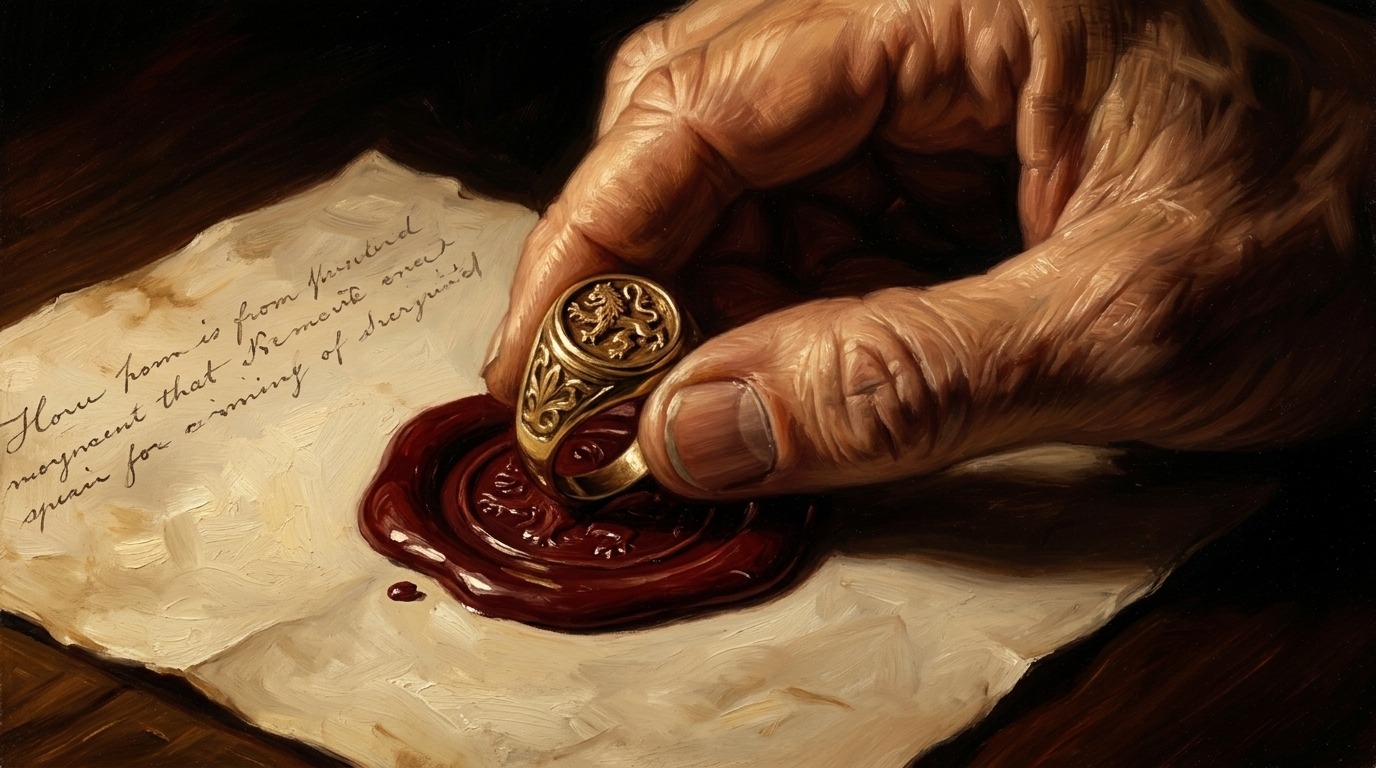
A hand presses a carved ring into hot red wax on a document called "Charter Secundus." That's it. No photograph, no notarized ID, no phone call to confirm anyone's signature. One ring, carved with one design, was the entire security system standing behind an important promise. An unbroken seal told the person receiving it something very specific: nobody had opened this before you did.
If a person's signature today could be perfectly copied by anyone with the right tool, what would have to replace it? Design your answer, even roughly.
Scene 2 — A Blueprint for Something That Didn't Exist Yet
Source: Illustration Notebook, Plate 03 — The Signet and the Charter, Element 2
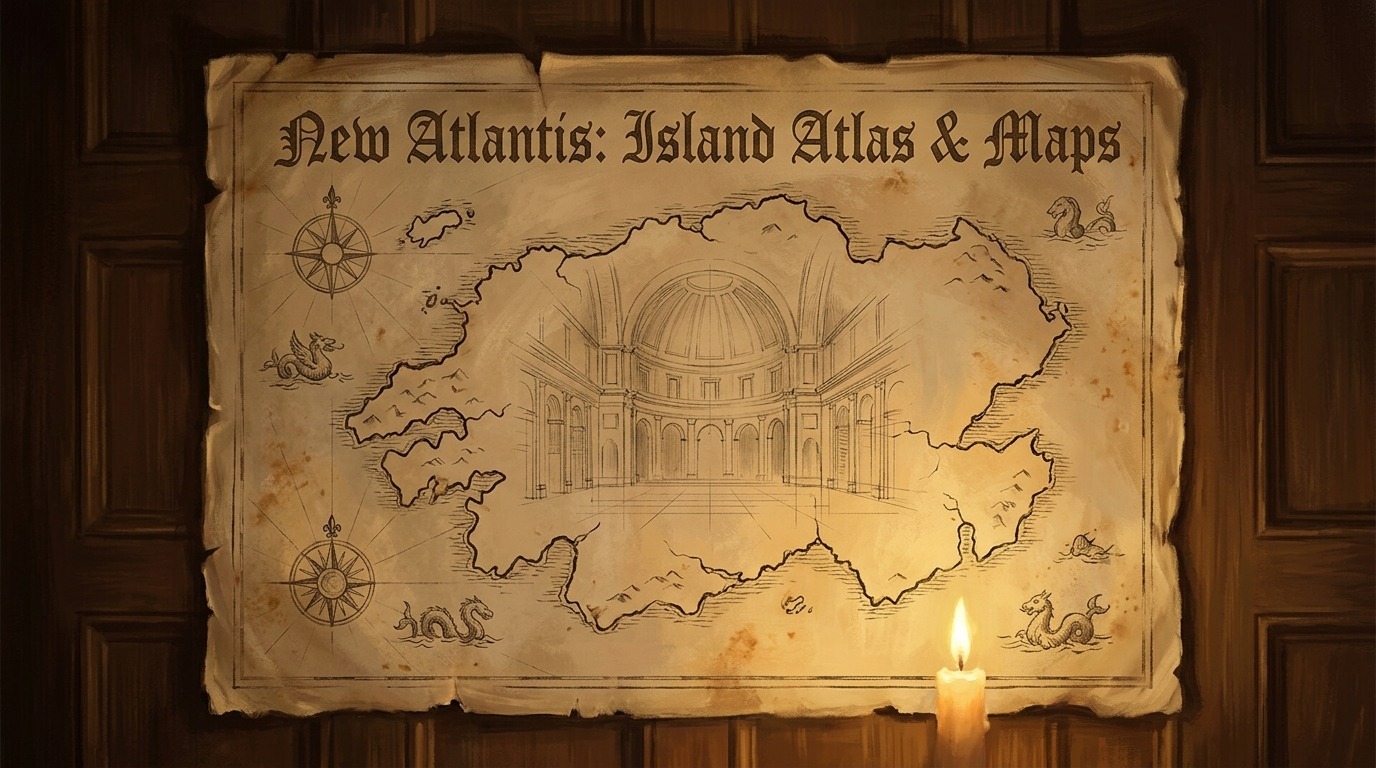
Behind him hangs a hand-drawn atlas labeled "New Atlantis." It's a nod to Bacon's own unfinished book by that name — a made-up island run partly by "Salomon's House," an organized institution built purely for scientific research and the public good. Nothing like that existed anywhere in his country yet. He sketched the entire blueprint anyway, on paper, inside a story, decades before anyone tried to build the real thing.
If you had to design, from nothing, the ideal place for people to learn and discover things, what would its very first rule be? Write the rule, then explain why that one comes first.
Scene 3 — A Vision No Clearer Than Smoke
Source: Illustration Notebook, Plate 03 — The Signet and the Charter, Element 3

Rising from the candle's smoke is only the barest suggestion of what these ideas might become — the impression of a domed hall, something like a greenhouse. None of it resolves into anything specific enough to name outright. It dissolves at the edges the way real smoke does, reading more like a half-formed hope than a claim. And the rest of the desk tells its own quiet story: an almost-empty wine goblet, bread down to its last crust, a cloak already hung by the door instead of being reached for. Beside a worn book sits a small stack of already-sealed letters, waiting to go out — not the first night like this one, and clearly not going to just one person.
Could you write down an idea today, fully expecting you'd never live to see whether it came true? Name one idea you'd be willing to write down on exactly those terms.
Scene 4 — The Three Who Said Nothing
Source: Illustration Notebook, Plate 03 — The Signet and the Charter, Element 4
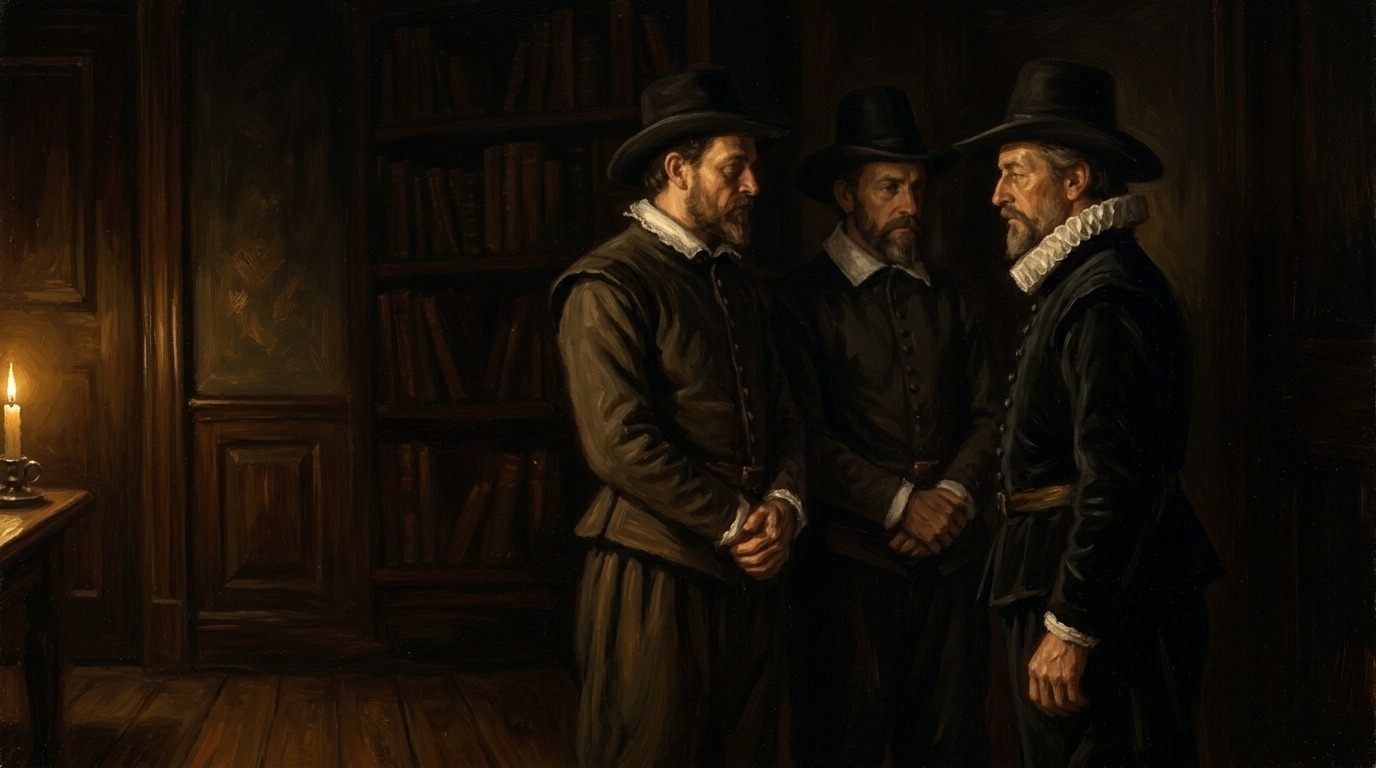
Three men stand quietly in the shadowed background, watching the seal go down. Important documents in this era often required exactly this — people physically present who could later swear, years afterward, that the right person sealed the right paper. There was no other way to prove it after the fact. Their silence in the scene isn't incidental. Witnessing was a real, formal, mostly wordless job.
Could you be trusted as a witness — someone who might be asked, years later, to swear under oath that you personally saw a specific moment happen exactly as it did? Write about a moment you actually could swear to, in that much detail, right now.
Scene 5 — The Book at the Table's Edge
Source: Illustration Notebook, Plate 03 — The Signet and the Charter, Element 5
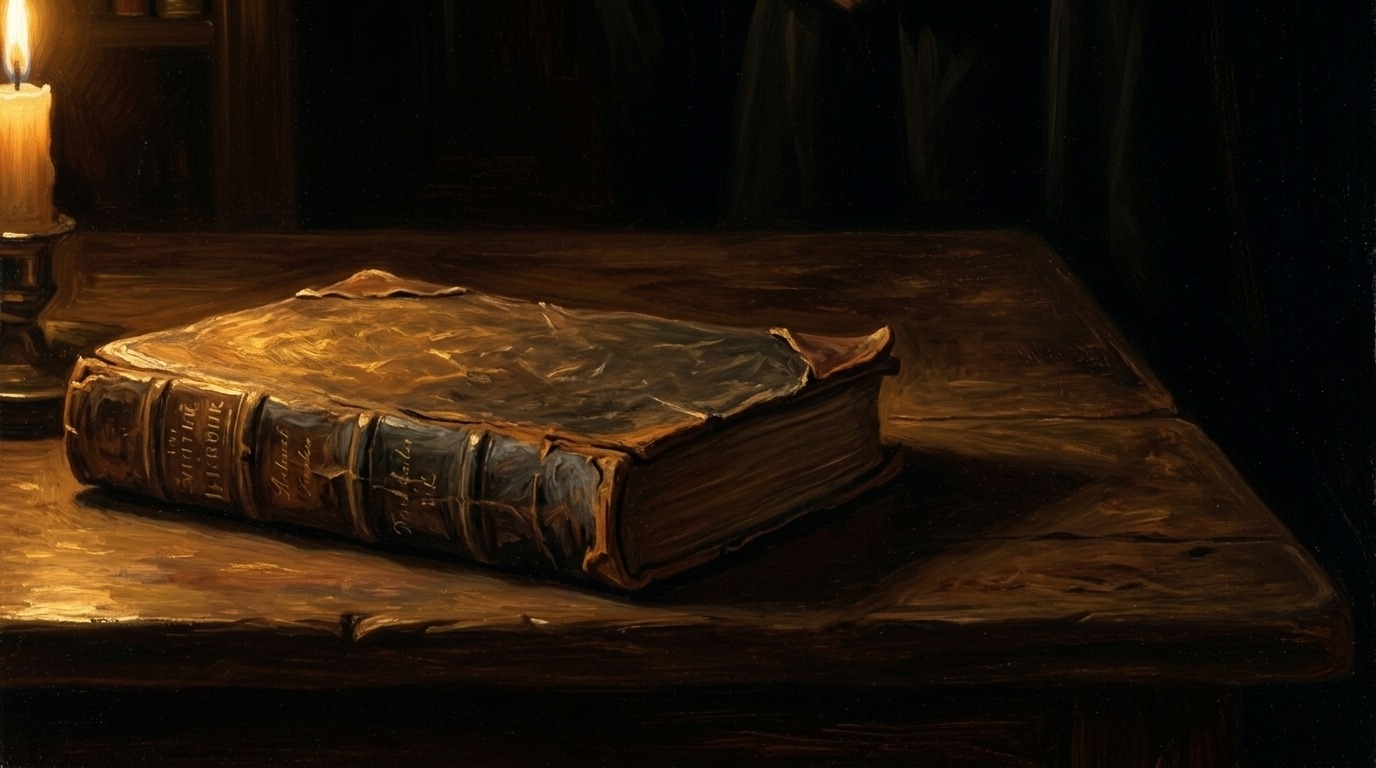
A worn copy of "M. Shakespeare's The Tempest" rests at the table's edge. It's placed there on purpose — a quiet nod to the authorship question running underneath a lot of this research: whether Bacon's own hand shaped work published under someone else's name. Nobody in this scene explains it. It's just sitting there, at the edge of the table, the same way it sits at the edge of four centuries of argument.
Could you keep authorship of something you made secret for your entire life, even after it became famous? Write honestly about what you think you'd actually do.
Why This Lesson Matters
Every scene in this Lesson is really the same question, asked five different ways: how do you make something trustworthy when you can't fully prove it? A ring pressed into wax doesn't prove who sealed a letter — it just makes tampering visible. Three silent witnesses don't prove a moment happened — they just agree to carry it forward in memory. A vision rising in candle smoke doesn't prove an idea will work — it just gets written down anyway, sent to people who weren't there to see it form. Even the book on the table's edge doesn't prove anything about who wrote what. It just sits there, unresolved, the way most real historical questions actually stay.
That's worth sitting with directly: almost nothing you build, promise, or create ever comes with airtight proof attached. You don't get to wait for certainty before you seal the letter, sign your name to the work, or tell someone what you're building toward. At some point you press the ring into the wax anyway, knowing it only proves that nothing was tampered with after — not that you were right.
This connects straight back to the last two Lessons. The hedge from Lesson 1 took years nobody could verify were being spent correctly until the shape finally showed. The candle from Lesson 2 lit hours nobody was there to confirm were spent well. This Lesson adds the third piece: even once the work is done, you often can't prove it was real, right, or yours — you can only seal it, sign it, and let it stand or fall on its own.
Keep the ring next to the hedge and the candle. You're about to meet a convoy trying to hold formation in water that doesn't care how good anyone's proof is.
Challenge Experience
To be written once all ten Lessons are drafted — held back so it can be built with the whole arc in view rather than one Lesson at a time.
Go Deeper
Matching the pattern used in earlier Lessons — real targets pending for the Bacon Cabinet link.
The Vanguard — song page, lyrics & liner notes
Read Episode III on Substack — "Gosnold and the Vanguard"
The Forgotten Father of America — Bacon Research Center, Finding No. 001
Placeholder — Read the full Episode 3 argument on the Bacon Cabinet